Monthly Archives: January 2014

Tomato soup – the best comfort food ever?

I’ve been soooo busy. Not quite sure what I’ve been doing (apart from my tax return), but I’ve been rushed off my feet. And last weekend I suddenly had to give lunch to seven hungry spinners. Spinners of wool, ahem, not spinners on bikes – but they get just as hungry. Soup had to be one answer; it so often is at this time of year… and raiding the freezer had to be another.

Now, I admit it, I’ve a weakness for at least one tinned soup – tomato. Who hasn’t? Well, apart from people who either don’t like tomatoes, can’t eat tomatoes or who, as in my case, are lactose intolerant – my favourite, Heinz, has milk in it (‘dried skimmed milk, milk proteins’ to be exact), as many do. And most of the prepared tomato soups also are high in an ingredient which I don’t use in mine, and which is finally getting the negative press it deserves: sugar. Half a tin – half a tin – typically contains nearly 10g of sugar, 2 teaspoons. Yikes.
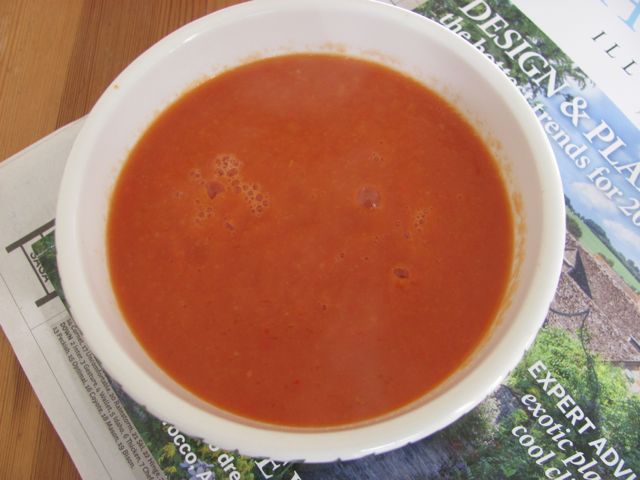
tomato and red pepper soupSo I recently set to work to produce as credible an imitation as I could, given certain variables, and I think I finally got there. As a result I had lots of single-portion containers stashed in the freezer, and boy did they come in handy. They weren’t all identical, as I’d been experimenting with different ways of thickening the soup, but they were close enough to work together well – and I just had enough for my starving spinners.

So here’s the recipe, and with the two most successful alternative ways of thickening the soup given: using a potato or some cannellini beans. For the latter, you can (of course) use dried beans instead of the tinned ones given in the ingredients; soak 120g overnight, then rinse and cook them until they are just soft before adding to the soup.

Tomato and red pepper soup
serves 4

1 tsp olive oil
1 large white onion, chopped
1 stick of celery, finely chopped
2 red peppers, de-seeded and chopped
2 large cloves of garlic, crushed
2 x 400g tins of chopped tomatoes
1 x 400g tin of cannellini beans, OR
1 potato, about 150g
half a tsp sweet smoked paprika (pimenton dulce)
a few thyme leaves
salt and black pepper

Warm the oil in a large casserole or pan over a medium heat and add the chopped onion. Stir it in, then put the lid on and sweat the onion for about 5 minutes; check that it isn’t catching. Then add the celery, the peppers and garlic and cook, lid off, for a further couple of minutes.

Add the tomatoes (if using whole tinned toms instead of chopped ones because that’s what you’ve got in stock, break them up in the tin first). Drain and rinse the cannellini beans, if using, or peel and chop the potato, and then add to the pan. Finally add the paprika and the thyme leaves, then stir everything together. Fill the empty tomato tins with water, swirl round to collect all the tomato juices, and add them to the pan too.

Cook, uncovered, for 20 minutes or until the peppers are soft; add a little more liquid (boiling water or hot vegetable stock) if the soup looks as though it’s going to be too thick, but try and wait until after blending because this soup is best quite thick, and it’s difficult to judge when it’s still in chunks. Blend the soup until it’s smooth, and then add more liquid to get the consistency you prefer. Reheat the soup, check for seasoning – and serve with some chunky wholemeal bread.

(On the sweet smoked paprika – it’s getting easier to find, but the most frequently stocked smoked paprika is the hotter one. The really useful sweeter version can be bought economically online if necessary, and a tin will last for ages.)
The elephant in the foodie room

I can’t ignore this one any longer, and I’m not apologising if it turns into a rant (though I’ll try and control myself, honest, keep my red flag furled and my barricade-building tools firmly in the shed).

Sometimes the world of food writing can seem a little precious. Obviously there are some great exceptions, from food campaigners to bloggers who push eating well on extremely little money, and they’re brilliant. But it really hit me in the run-up to Christmas this year, reading reviews and flashy ‘best-buy’ comparisons in the media, that many food writers appear to operate in an exclusively well-off, middle-class, home-counties bubble full of exclusive restaurants and exotic ingredients. And yet there is a massive food story going on at present which many people are failing to cover. It’s not glamorous, it’s not going to inspire an elegant table setting or chic contribution to a dinner party. But it’s everywhere; nowhere is immune, even my own community here in beautiful, picture-postcard Snowdonia.

When I was about thirteen, I remember asking my father about the lack of younger people in the part of Sutherland that was so dear to us. Ever political, he took care to explain the economic situation in detail, much of which I don’t remember clearly. But I do remember his closing statement, almost something of a cliché, but true nonetheless: you can’t eat scenery.

Living somewhere beautiful is no barrier to deprivation. Turn your back on the beautiful views and look at the increasingly run-down council estates; go off the main road and explore some of the ex-slate-mining towns and villages which the newer road has bypassed. We tend to think of economic deprivation as being an urban problem, but it isn’t. Recovery? What recovery? There isn’t much of one in some of the places I know well. And this is where the food banks come in.

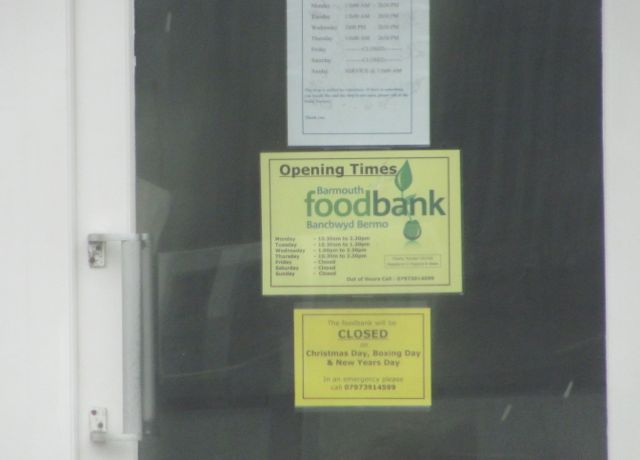
food bank hoursEighteen months ago there was one official food bank in North Wales, in Mold. Now we are further into this alleged economic recovery we are apparently having, and strangely they have increased in number, and are continuing to do so. Food banks now cover more of Flintshire as well as Wrexham, Caernarfon, Denbigh, Welshpool, Bangor and even the jolly holiday town of Barmouth. And those are just the ‘official’ ones.

There are many other community- and church-based ones, such as one in Pwllheli. Some have a web presence (like the splendid Telford Crisis Network), but more do not and rely on word of mouth. Some are purely individual, prompted by highly-motivated people, such as one which sprang up in Rhyl recently. Their contribution isn’t quantified but, bearing in mind that Trussell Trust food banks alone fed nearly 350,000 people in 2012-13, it has been estimated that they have helped over 500,000. The Trussell Trust pulled out the number of children from their stats: 126,889 kids were fed by their food banks in the same period. These figures do not include this Christmas season, when some anecdotal evidence I’ve been given points to even more use.

I find it depressing that there are members of the current administration who decry the existence of the food banks which, according to them, are unnecessary and have a ‘political agenda’. There have also been comments about the banks supplying exotica, so let’s look at the typical shopping list recommended by the Trussell Trust (I was given a copy when the Barmouth bank started collecting outside local supermarkets, but it’s on their website). Powdered milk, sugar, a carton of fruit juice, bottled pasta sauce, tinned soup, baked beans, tinned toms, tinned sponge pud, tinned rice pud, cereals, tea, instant coffee, rice, pasta, tinned meat or fish, jam and biscuits. Pretty wild, huh? And it’s also been reported that some people have been returning those items in their boxes which require heating up. They can’t afford it.

Now I’d like to think about the reasons why people end up – at the end of their tether, having tried everything else and often deeply ashamed – using food banks. Yes, there are more food banks, so more people are using them (that’s the ‘reason’ given by some members of the government for their increasing use), but a food bank is not something that’s set up on a whim, nor can someone in need just materialise at a Trussell Trust food bank and demand some tins of rice pudding – they have to be referred. Right, here goes: benefit delays bring 29.69% of people; low income, 18.45; benefit changes, 14,65; debt, 9.52% – and so on. The full list is on the Trust’s website.

Presumably the Red Cross have a political agenda too, since they’ve also been organising food collections in the UK in the run-up to Christmas. The last time they were involved in large-scale food aid here was during WW2. Just saying.

I’m lucky, and I know it. It’s not that I’ve got lots of money – I haven’t; I’ve spent years working around the book trade and that does not bring you great riches, even when augmented by freelance journalism – but if I want a delicious bar of artisan chocolate from the farmers’ market, if I want to test the latest blend from a local coffee roaster, I can afford it. I’m sensible, though. I don’t see this as meaning that I have to miss out on anything, except possibly roast peacock stuffed with truffles, but sooner or later Lidl will add that to their frozen foods alongside the lobster. I am lucky. And it’s no great loss to me if I add a tin or two of soup to my basket, or buy something I normally would not, like powdered milk.

Just one final word before I get off my soapbox and back to cooking. In the 1920s, Joseph Rowntree didn’t contribute to the soup kitchens in York (another place long combining picture postcards and poverty), despite his wealth. Instead, he set up his Trusts to try and do something about the root causes; check out the Joseph Rowntree Foundation’s website for more up-to-date information on the whole issue. So while things like food banks will always be a sticking plaster, I take the view that the sticking plaster is necessary. People can and will be very generous (on one collection day before Christmas, the Tesco Extra shop in Talbot Green couldn’t cope with the amount being donated, for example; some people gave whole trolly loads to the Pontyclun food bank), but it doesn’t mean you should lose sight of the underlying wound…