Monthly Archives: June 2014

Kitchen kit to fight for

I was making bread this morning when my Kenwood Chef started making ominous protesting sounds. It’s an old model, because my experience of the latest ones could best be described as profoundly negative (any further explanation would consist of much swearing, shouting and the hurling of ‘guarantees’ across the kitchen) but It’s been fine. Not as fine as my old old one – if you see what I mean – which was given to me when one of my neighbours died. That had been deeply loved, had a history and a hand-sewn cover but it also died eventually; my ‘new’ old one came from eBay. It was reconditioned, and it worked just fine.

Due to repeated hand injuries, I can no longer do all the kneading by hand when I make bread. So what to do, now that my Kenwood is doing banshee impressions? I’ve tried no-knead or short-knead breadmaking methods and I either don’t care for the end result or can’t manage my life with a stopwatch (8.30: knead the dough for 10-15 seconds … 9.00: knead the dough for 10-15 seconds…).  So I’ve settled for a tortoise approach – I’ll think about it when I have to. But in the meanwhile it made me think about what equipment I had that I couldn’t live without. Well, obviously I could, in extreme circumstances, but hey.

I’m baking at the moment, so I initially considered the things I use for my bread. I wouldn’t care to be without my bannetons – Carrefour, I love you – but if needs be, I can improvise with a bowl and a linen tea towel. Then there are the two ancient dough scrapers, which are fantastically useful. I suppose I could improvise an alternative? Yes, I know I could – I once used a credit card. It was never the same again, but that was probably just as well. What about a flour shaker? Obviously I could just chuck flour over the linen tea-towel in my banneton bowl, the worktop, the floor, myself and Next Door’s Cat who thinks he lives here; that would work.
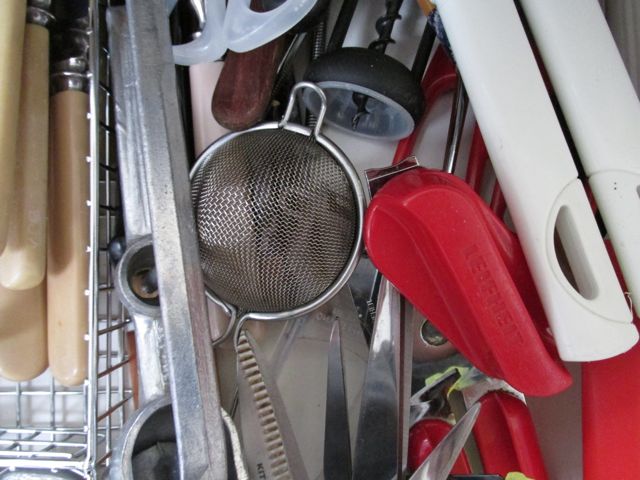
aghI was on a roll (otherwise known as waiting for the oven to heat up), and opened the stuff drawers. I remember an episode of Gavin and Stacey, in which everyone was searching for a take-away menu and it was suggested that it might be in ‘the messy drawer’. All my drawers are like that. Time to sort them out, perhaps.

There are three of them, vaguely organised by diminishing frequency of use. So drawer one consists of cutlery and things like scissors and tin openers and corkscrews and a digital timer; drawer two has bulkier stuff like a plastic funnel (so attractive), pizza cutters (plural? How did that happen?), graters, hand whisks and rolling pins, and drawer three is the – well, the one-offs. And then there are the old pickle jars (three of those too) which hold the wooden spoon collection and the collection of – er, more stuff. Spatulas, etc. (A new swear word, I think. Oh, spatulas!)

I used to be, you see, an equipment slut. Used to be?

agh 2I blame Divertimenti (you’ve got to blame someone). They used to be on the Fulham Road, and I didn’t live that far away, plus I was at the stage of being in my first place and just having to add to my kitchen. And they opened on Sundays, or am I imagining that? Anyway, I would spend far too much time wandering around, picking up expensive pans, putting them down again, fondling obscure pieces of kit and buying some of them.

It’s the resulting one-offs that I could easily live without – crème brulée iron, anyone?  – though I have to say that an oyster knife is just perfect for getting solid lumps of dried mud out of the tread on your walking boots. How my life has changed.

spoonsAt some points I’ve improvised alternatives for all sorts of things. An wine bottle can sub as a rolling pin, and I have opened a tin by stabbing it repeatedly with a screwdriver (er, not recommended at all, plus it takes ages). I’ve whisked with a fork, which worked though it did take a couple of days to regain the use of my shoulder. Much as I love my ancient wooden spoons, and despite the extent to which I am baffled that some people manage without any, I could always use a stick.

(What sort of future am I envisaging here, I wonder? I’ve been reading something about partisans behind German lines in Eastern Europe which may account for this whole speculation, but have no intention of eating very old, very dead horse. Or people, but we won’t go there.)

It was only when the bread was cooked that I realised the piece of kitchen equipment that I absolutely cannot do without, or rather the pieces. I could throw everything out tomorrow, but leave me my knives. And a steel. They’re nothing flash, just a selection of Kitchen Devils and a rather old Prestige bread knife with a naff red handle dating back to the late 1980s (guess who had a red and white kitchen? Must have looked like a pizzeria). But I keep them scarily sharp and love them dearly. I’ve had ‘posh’ knives, and I’ve got rid of them, finding them more trouble than they were worth (and pigs to sharpen, too). So take my dariole moulds if you must, but leave me my four-inch vegetable knife.

And a corkscrew. Natch.

Summertime tart

I do pastry. I do bread, too. But I can’t do cakes – or rather there are a limited number of cakes which I can do, and which work well. But something like a Victoria sponge? Touch and go. However, pastry – no problems. So when I know people are coming round I don’t make a cake, I make a tart. Or perhaps I’d better call them flans, to avoid any sniggering at the back. Nope – tarts they are, and tarts they will remain. Or tartes, since the origin of mine is indisputably French.

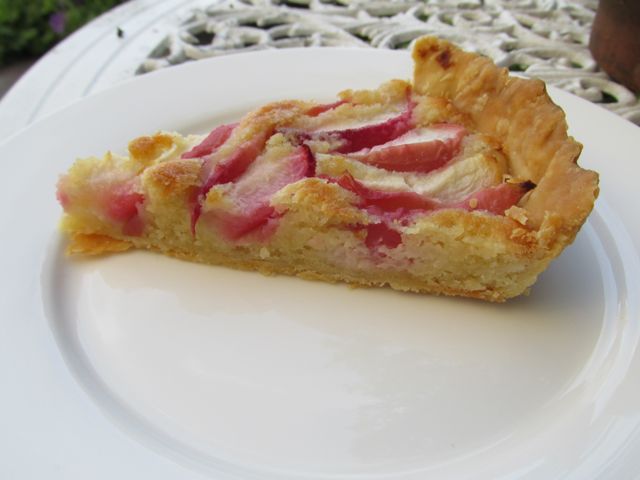
tarte aux brugnonsThere is something about a slice of fruit tart served on bone china, with a healthy dollop of cream or Greek yoghurt. It somehow feels special, more special than a slice of Victoria sponge – given the nature of my sponge, this is not surprising, mind. So when I knew I had people coming round and spotted that the Co-op had suddenly received a consignment of white-fleshed nectarines and were selling them off cheaply for some reason (I’m not complaining), I felt the call.

So what about pastry? Is it phenomenally difficult? I don’t think so, but then there are people out there who wouldn’t believe that a grown woman could mess up a Victoria sponge. There are all sorts of stories about chilling your hands in cold water or – I kid you not – wiping ice cubes over the surface, and lots of people have unorthodox methods that work for them. You do need to keep pastry cool, of course, but my hands aren’t particularly chilly, my worktop is unbrushed by ice cubes and my pastry still works. Just chill it (man). As long as the pastry is a fine crispy shortcrust, it doesn’t really matter how it’s made.

Anyway, here goes, my fruit tart made with pâte brisée, a version of the classic French shortcrust which I have found works really well. In the UK, it’s usual to rub the fat into the flour first; in France you don’t. I go for the British way because I just hate breaking up raw egg with my fingers (eeeeuuh).

Nectarine tart with almonds
for a 23cm loose-bottomed tin

For the pastry:
50g butter, at room temperature
125g plain flour
I small egg

Make the pastry first, because it needs to chill for 30 minutes and will be baked blind, anyway. Put the butter into a large bowl and cut it into small pieces with a knife. Sieve the flour into the bowl and then rub the two together with your fingers until the mixture resembles fine breadcrumbs – this always takes longer than you think. Then add the egg, break it up with a fork and mix it in well. The pastry will come together gradually into a soft dough but don’t knead it like bread, just press it together gently and add a little very cold water if necessary – but it probably won’t be. Form it into a ball, put it into a clean bowl and cover it with clingfilm. Chill in the fridge for 30 minutes.

Pre-heat the oven to 200 degrees C, 180 fan, gas 6 and grease a loose-bottomed quiche tin. Lightly flour the worktop and take the pastry out of the fridge. Warm it up in your hands a little to soften it, then carefully roll it out into a circle, changing direction and turning it over; keep the worktop floured while doing so. Lift the pastry up, over the rolling pin, and carefully drape it over the tin. Then gently manipulate it into the corners and folds of the tin (patch any gaps; dip a pastry brush in milk and stick a new piece of pastry on top). Trim off the excess, ready for baking the case blind. Prick the bottom of the pastry and line it with a generous circle of greaseproof paper, tip a load of dried pulses or baking beans on top of the paper and bake for 15 minutes. Set it aside to cool for 10 minutes, then remove the baking beans and paper and let the case cool completely.

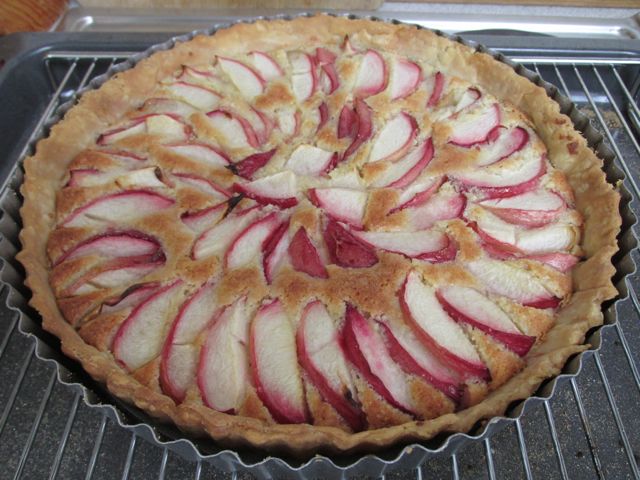
tarte 2For the filling:
80g butter
80g vanilla sugar
1 large egg, beaten
2 tsp Amaretto (optional)
100g ground almonds
1 tbsp flour
5 small nectarines

Pre-heat the oven to 200 degrees C, 180 fan, gas 6.

Cream the butter and sugar until light and fluffy. Gradually beat in the egg, adding a little of the flour as you do so. Then stir in the Amaretto, ground almonds and the rest of the flour; mix everything together well. Put this mixture into the tart case and level it down. Cut the nectarines into slices and put them on top of the filling in a circular pattern, saving the smaller slices for the inner circles. Then sprinkle a little more sugar on top and bake the tart in the oven for 10 minutes. Lower the temperature to 180/160/gas 4 and cook for another 20 minutes or so – check towards the end to make sure the fruit isn’t catching (a little caramelising is fine; burning is not, ho ho, don’t ask me how I know).

Serve warm (rather than hot) or cold. Cream or good Greek yoghurt served on the side is wonderful. Sigh.

Hot weather soups

Today the title of this post seems a little optimistic, but I’m hoping I can entice the warmer weather back by stating it as a fact. Well, it might work…

I am, without any doubt, a soup addict but at this time of year even I go off them a bit. After I abandoned a bowl of mushroom soup the other day I decided I needed an cold alternative, and one that wasn’t gazpacho. So I turned to one of my favourite books, Lindsay Bareham’s Celebration of Soup, and there were a few interesting suggestions, though not a lot – but many of them foundered on the fact that I’m lactose intolerant. I have to avoid milk and cream, and though I could now take a tablet which would enable me to digest lactose, many years of white liquids making me ill means I contemplate them with distaste (but yoghurt is fine; the bacteria in yoghurt help generate enzymes which digest lactose; go yoghurt).

cold soupThen I went back to some of my other, often older, books. An obvious choice, and a version of which does appear in Soup, was a Middle Eastern one, a classic which crops up in many sources: cucumber, yoghurt, garlic, mint. A lot of the versions I found used cream, like Lindsey Bareham’s, so I decided to go back to the absolute basics and see if it was really necessary…

Cold cucumber, mint and yoghurt soup
(serves 2, generously)

a sliver of butter
1 tsp olive oil
2 shallots, peeled and chopped
1 cucumber, peeled, deseeded and chopped
1 clove of garlic, peeled but whole
a good handful of fresh mint, chopped
500ml natural yoghurt
salt and white pepper

Melt the butter with the oil in a heavy-bottomed pan over a gentle heat. Add the shallots and allow them to cook – without browning – for a few minutes and then add the chopped cucumber. Cook for another 5 minutes, stirring and checking that there’s no hint if browning, and then add about 300-400ml of water – enough to cover. Cook, very gently, for 5 minutes more. Keep checking that there’s enough liquid and add a little more if necessary. Add the chopped mint and cook for another 10-15 minutes, or until the shallot and cucumber are really soft and the liquid has cooked well down.

Put a sieve over a large bowl and empty the vegetables into it; remove the garlic clove and discard it. Work the soup through the sieve with a wooden spoon. Discard any bits which won’t go through – there shouldn’t be much – and scrape any pulp off the bottom of the sieve into the bowl. Test the soup base; by now it should be tepid. Add the yoghurt and stir it in (a whisk is useful) until it has a texture similar to single cream; thin with a little water if necessary. Check for seasoning, cover the bowl and chill in the fridge for a minimum of 2 hours.

(Removing the garlic after cooking is optional. Including it can make the soup taste overwhelmingly garlicky, but if it’s mild you could leave it in – chop it roughly before cooking, though.)

mintI grow a lot of herbs, and currently have six different mints; for this soup I used a mixture of spearmint, garden mint and a Moroccan mint, plus something described as ‘chocolate mint’ on the label. Happily, it doesn’t taste remotely of chocolate…

I also grow lovage, and that gave me an idea for another soup, made along the same lines:
celery and lovage soup.

I won’t bother to write out all the method again, as it’s essentially the same. For two, I used a whole head of celery, including the leaves, and 4 shallots; no garlic. I trimmed the celery but didn’t de-string it before chopping. I cooked these gently down, this time using a neutral rapeseed oil, and needed to add more water so they didn’t catch; they also took longer. I added a good handful of chopped lovage leaves after 25 minutes, and cooked the vegetables for another 10. The pushing through the sieve produces more pulp for discarding – mostly celery strings as far as I could see – and I had to be careful when scraping the pulp off the bottom of the sieve as some of the strings worked their way through at the end. I didn’t need quite so much yoghurt to get the right texture this time. This celery and lovage soup has a delicious, almost lightly curried flavour, and I ground some black pepper over it before serving rather than adding white pepper before chilling. Yum.

Very refreshing, and doubtless there’ll be more experimenting before the summer (HINT, weather gods) is over. I can’t do without my soups.

I can do without some things, though. Several of the authors of the older recipes I uncovered in my ridiculously large collection of cookery books obviously felt that subtle colour wasn’t good enough. Personally, I don’t see lots of green food colouring as a necessary soup ingredient (eek)…