All posts by Kate

Unknown's avatar

About Kate

Writer and editor, with an unhealthy (or rather healthy) obsession with food...

In the hungry gap…

Every year I end up in this position come April and May. Nothing to eat. Er, except for a huge stash of frozen green beans, and they’re beginning to pall a little.

dig for victoryIt may seem surprising to anyone who doesn’t grow vegetables – though obviously we all should (!) and this is an accurate depiction of me, by the way – but this is the time of year when home-grown produce is thin on the ground. Traditionally, it’s the season when labourers and peasants’ resources were at their most stretched and starvation was a real possibility.

Happily that’s not (quite) the case now, but it can still be an issue for anyone who likes to grow as much of their own veg as possible. There just isn’t that much available. Brassicas and the like are mostly over by now, going to seed as the temperature increases, and nothing else has yet come on stream.

Admittedly there is a variety of kale which fills the gap – introduced to Britain in 1941, when it was most desperately needed – but I’ve lived on kale at this time of year before now and I’m not keep to repeat the experience. And that’s what it does: repeat. I shall say no more, but my decision has been a popular one. If you’d like to test it for yourself, Chiltern Seeds usually have Hungry Gap Kale. It’s frost resistant (not a problem for me), and it does have a good flavour, but… oh, yes; I said I would say no more. Instead I’m just going to stand in the garden and sigh.

We are still lucky though. Not only can we garden without the risk of enemy parachutists landing in the potato plot, we can supplement our stock with food from the shops. And even if we try not to fall back on that to any great extent, we do not have to actually can anything, though apparently one in five US households still do. Listen to Betty MacDonald on the perils of home canning in the late 1920s:

First you plant too much of everything in the garden; then you waste hours and hours in the boiling sun cultivating; then you buy a pressure cooker and can too much of everything so it won’t be wasted. Frankly I don’t like home-canned anything, and I spent all of my spare time reading up on botulism…

That risk still exists today: between 1996 and 2008 there were 48 outbreaks of botulism in the US that were directly linked to home-canned food, and botulism kills – nastily. To me, this doesn’t sound like something I should be doing; I’m thinking the Russian roulette scene in The Deerhunter, but with a jar of home-canned cauliflower.
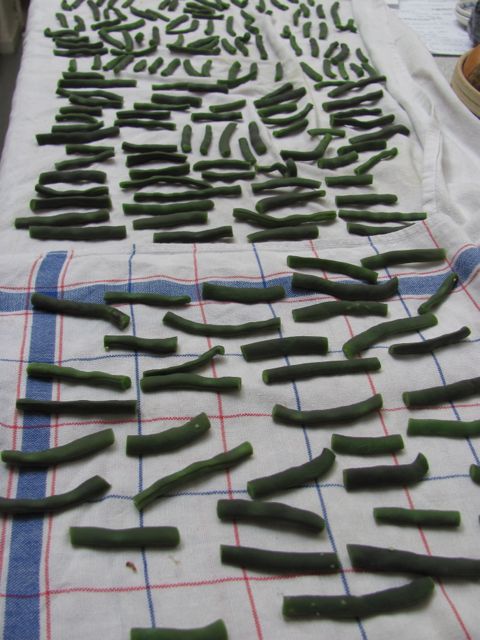
beans dryingThank goodness we have freezers now (admittedly freezers full of french beans). Incidentally, the same over-production addiction – Betty MacD. noted that her neighbours were eating the season before the season before’s produce, and were still planting and planning on canning the current season’s stuff – applies today. I know I don’t need quite so many climbing beans this year, but guess what’s in the cold frame, ready to go out?

And in a few months time they’ll have been blanched and be drying off, ready for packing and putting in the freezer…

I’ve seen all sorts of alternative suggestions for things to fill the hungry gap but I’m not sure I could live on asparagus – and though I wouldn’t mind trying the season is short and doesn’t actually fill the gap. However, these ‘options’ mostly come down to other brassicas – purple sprouting broccoli, spring greens, and more kales – and in my experience most of these are already bolting. Squashes, if seasoned well in a good autumn (and that’s a big ‘if’ for me here in Snowdonia) will keep, but even they are failing now, going a little squishy at the base or stalk or, alternatively, getting so hard you have to take an axe to them. Leeks can stay in the ground so they’ve been recommended, but by late April they’re generally sending up spectacular seed heads or are so woody as to be unusable. It’s that HG kale or diddly squat. Diddly squat, then.

Despite this, I rather like the hungry gap in a perverse way, even if I am fed up to the back teeth of frozen beans. It connects me one of the main reasons I bought a house with a decent garden: feeding myself. It reminds me that food should never be taken for granted, and that seasonality should be a factor in my diet. The more I rely on out of season foodstuff from a supermarket, the greater the negative impact on the environment. I know it’s only a small thing, but lots of small things make a bigger thing. And in my case, a giant vegetable soup. Or Spanish green beans. Or green beans with tomato. Or a green Thai curry featuring – you guessed – green beans. Or just plain green beans with tomato sauce and fish fingers (getting desperate here). Green bean terrine?

Hang on a second – there is something other than frozen beans, though I’m not quite sure it’s a substitute for tomatoes, spuds, onions, beetroot, courgettes. The rhubarb looks promising…

Ooo matron (or the love of sausages)

What is it with Brits? When it comes to humour, most of us dearly love a double-entendre or anything scatalogical. When I was doing stand-up I sometimes felt that I could abandon my act and say ‘bottom’ for 20 minutes, and get the same hysterical response. Mind you, I was never brave enough to try it, not even at the midnight show at the Comedy Store.

So it’s probably best to confront all the Carry-On style double entendres immediately. This post is about sausages. That’s right, sausages: ‘An item of food in the form of a cylindrical length of minced pork or other meat encased in a skin, typically sold raw to be grilled or fried before eating’, to quote the OED, and absolutely nothing else. OK?

We’re very lucky round here in that many of the butchers take pride in their ‘item[s] of food in the form of a cylindrical length of minced pork’. Perhaps it’s not surprising; there’s a long-established tradition in Britain of local pig-rearing and smaller-scale butchery. Admittedly the small-scale butchery nearly disappeared, but, like some other food traditions – decent breadmaking, for instance – care and attention are again being given to pork products, and on a satisfyingly artisan basis.

Bewick cottagerAnd, even if we haven’t all quite got back to the point where there are piglets playing about while we hang out the washing, the tradition of small-scale pig-rearing is also beginning to reappear.


Some of my friends, for instance, have a pig-sharing thing going on – one rears the pig, the rest share the expenses and will get a share of the haul. But it’s not for me, despite the fact that I do have an old pigsty available. First, the neighbours would probably object, especially the Chapel next door; second, the pigsty is now a garden store and I’d have to clear it out if I wanted to keep a pig. Third, I must admit to being a bit nervous around pigs: I’m no Lord Emsworth, and they are big. One farmer I know had an enormous evil-tempered sow straight out of Celtic myth, and she scared even him (the sausage maker got her in the end; while it would be exaggerating to say that his village put the bunting out, many people were relieved – she’d been prone to escaping).

And, of course there’s that other reason: I can get good sausages and bacon easily, and  without all the fuss, bother or inevitable deterioration in neighbourly relations. The Spar shop in my village houses an award-winning sausage maker; there are multiple delicious choices at the local farmers’ markets and even the local Co-op does a good selection in their premium range. I’ve tried many of the flavouring options available and am currently coming down in favour of cracked black pepper sausages, either from local producers Oinc Oink (a happily bilingual name – there’s no ‘k’ in modern Welsh) or Ynysgyffylog. They’ve got enough punch to stand up to all sorts of other ingredients and are perfect for when I want exactly that impact but without the garlic of my local butcher’s best Toulouse-style sausage (itself ideal in cassoulet). And when I can’t get any of those, largely down to bad planning on my part, I get the Co-op’s Lincolnshires. Very good, very sage-y, as a good Lincolnshire sausage should be.

Ever since I discovered a tasty recipe in an old copy of Katherine Whitehorn’s Cooking in a Bedsitter I’ve done much more than simply bake / fry / grill sausages and serve them neat, as it were (I did adapt the recipe, which was from 1974 – tinned carrots? I think not…). A good sausage is a good sausage, no matter how you cook it – and a bad one will always be a disgrace, much more appropriately found – and left – in CMOT Dibbler’s tray in Ankh Morpork than in my sandwich / bake / ragout / salad. Their potential is enormous, as indicated by all the /// alternatives. So here’s my latest recipe, a warm salad. The weather isn’t summery enough for a cold one. Yet.

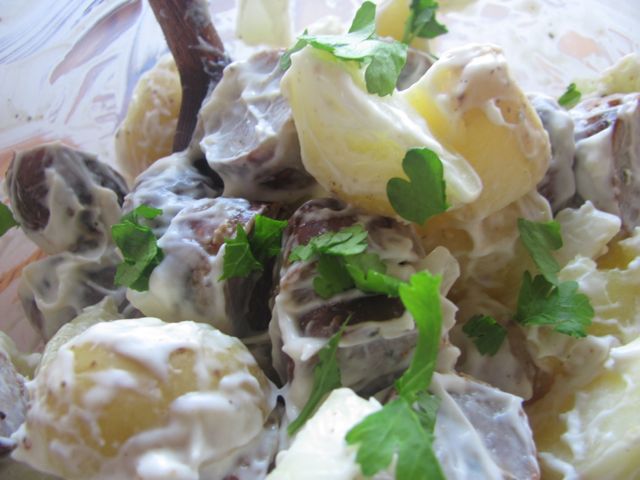
saladWarm potato and sausage salad
Serves 2

The recipe uses cooked sausages. I bake mine, while I’m cooking something else, at about 180 degrees, 160 degrees fan / GM 4 for approximately 30 minutes (depending on their thickness). I then let them cool completely. It’s the spuds that are warm, not the bangers…

200 – 250g new potatoes
6 well-flavoured sausages, baked, chilled
3 sticks of celery
2 banana shallots or 1 small red onion
2 tbsp mayonnaise
1 tbsp Greek yoghurt
1 heaped tsp Dijon mustard
a little salt
lots of black pepper
a large sprig of parsley, chopped

Chop the potatoes into chunks no bigger than 2cm, and put them in a pan of cold water. Bring to the boil and simmer until cooked. While the potatoes are cooking, chop the cold sausages into slices and put them in a large bowl. De-string the celery sticks and chop them up too, then add to the bowl as well. Cut the shallots in half and remove any greenish centres which can be bitter, then slice them into rings and add to the bowl as well.

Test the potatoes and check that they are just tender, then drain them well. Add them to the bowl and then quickly add the mayo, yoghurt and mustard. Add a little salt and turn the salad over carefully with a wooden spoon; the potatoes should not break up, but everything does need to be covered in the dressing. Add lots of black pepper and a good handful of chopped parsley and stir gently once more, then put it onto warmed serving plates. Serve immediately, with chunks of bread.

(And then steal any left-overs…)


Service, or tablecloths?

Casual dining is apparently bang on the button, it’s the cat’s eyebrows, It’s now, it’s so hot it’s cool.

Sorry about that – they’re all phrases (well, except for feline facial hair, but it’s probably only a matter of time) I’ve seen or heard which describe the fact that Marcus Wareing’s reopened restaurant is introducing a ‘new informal style of service’. Another top chef has dispensed with tablecloths: Kenny Atkinson was quoted in the Guardian as saying ‘I can’t spend £13,000 a year on laundry.’ None of this, of course, means that these places are suddenly going to be anything other than very expensive, but hey. Maybe it’s a start.

This made me stop and think for a while. What do I most remember, the surroundings or the service? I certainly remember bad service. Slapdash in Dublin; bordering on the aggressive in a top chef’s place in central London – ‘you will be vacating this table in the next twenty minutes’; nope, it wasn’t a question and, yep, it was just after 8.30. There was a Chinese place in Soho which was so notorious that people actually went there to experience the terrible service (the food was OK, though). I was there once with a Cantonese-speaking friend. There was the most enormous argument, and later she said that the bad service appeared to be a deliberate choice. A reputation feeding on itself, perhaps.

Menu outside the Petite Syrah in NiceIn semi-defence of the entire restaurant industry I must say that bad behaviour from customers often engenders the bad behaviour from staff, and there was some wry amusement last year at a cafe in Nice, which charged different prices for coffee according to how polite you were (photo courtesy Nice Matin).


Now I’ve done some waiting in the past, and customers can be very strange*, even when they’re not spontaneously rude. I had one woman who asked for more napkins because a huge sunburn blister on her leg had just burst – nice – and everyone who has worked with the public will know that some people are just spoiling for a fight. They don’t really need a reason; maybe somebody pipped them to a seat on the Tube, maybe their boss stared at them in a funny way – and so they look for someone to bully who can’t bite back. I can, and I’ve never lost a job because of it.

When I was first in a position in which I had to manage people who dealt with the public I used to say ‘treat customers as you would like to be treated’. No grovelling, no aggression, no indifference. Be polite, be courteous, but without any forelock-tugging whatsoever; just be friendly and helpful. (Oh yes – and ‘get me if they’re really horrible’.) The more I think about the service I would like to receive now, the more I realise that I somehow got it right even though I was very young – right for me, at least. That’s exactly what I want when I’m eating out.

So has anywhere got it right for me? I can immediately think of one example: the late-lamented Yetman’s. This small restaurant used to be in Holt in Norfolk, where I hired a cottage every spring for a few years to get away from ‘work’ work and do some real work instead. There was a sense of occasion there, not least because of Alison Yetman’s great cooking, and the service (from Peter Yetman) was great. It wasn’t laid back, though some critics felt it was; I found it confident, relaxed and deeply enthusiastic about the food – ideal. Above all, it wasn’t intimidating: no ‘sir’ or ‘madam’ stuff; you didn’t feel out of place in jeans, and you certainly weren’t treated any differently if you did turn up in denim. But there were big vases of flowers, comfy chairs in which to relax while you ordered, crisp tablecloths and napkins, and I liked all that: it added to that sense of occasion, florist and laundry bills or not. And that was – let’s see – must have been in the late 1990s.

So I don’t see why this ‘informal’ approach is being treated as though it was something new and insightful in a ‘fine dining’ (lordy, I hate that expression) establishment. It’s not. Informal service is not synonymous with bad service; top-end restaurants (and Yetman’s did have five stars in The Good Food Guide) do not have to have eighty-five waiters hovering around each diner, filling up wine glasses and brushing down crumbs every five minutes. Obsequiousness is not the same thing as great service.

dessertsI don’t think it’s just me.

I was staying in southern Normandy a few years ago, and there were two excellent restaurants nearby. The food was equally good at both, both had been equally well reviewed, and they both cost about the same. Neither was exactly cheap, and both of them had tablecloths (mais bien sûr).

The major difference was the service. One was a classic, preserved in aspic from the 1950s; the other was more modern in its attitude, more like a bistro, much more informal.

You could get a table at one of them whenever you wanted. Guess which? Yup. I am definitely not alone in what I prefer.

* OK, staff can be strange too. I helped a maitre’d friend a few times at a rather trendy restaurant in – no, let’s fudge and just say er, um, ‘in London’. It was perpetually short staffed, hence me putting on my black jeans and waiter’s half-apron. But I wasn’t the only helper… the boss was into S&M, and if things were really difficult he would ask what he revoltingly referred to as ‘my girls’ to come and help as well. We wore DMs; they wore stilettos (eek!). The kitchens were downstairs, and you could track the chef’s mood by the number of crumpled pieces of foil about the place – volatile, generally. One summer evening there was a mighty scream, and one of the ‘girls’ came running into the restaurant, followed by the chef wielding a large knife. What I couldn’t see was that there was a large rat between them: she was running away from it and the chef was chasing it, intent on rodenticide. Fortunately it was a Tuesday and it was pretty quiet, but any decent customer service which had been happening died on the spot (unlike the rat, which apparently ran off through the open door). I defy anyone to recover from that one…

To ramson or not to ramson…

Ramsons – aka wild garlic, stink bombs or stinking nanny (I kid you not), correctly Allium ursinum, has been, for the past couple of years, the hot fave trendy wild food. Think forgaging, think ramsons: that’s been the message in some quarters.

ramsonsThe plants are easy to identify (even easier once they’re in flower), they’re easy to gather and they’re prolifically present in hedgerows and woodland – and my garden – just about now. And now’s the perfect time, because the leaves are still young. Plus it’s the start of the hungry gap, the time when stored fruits and vegetables have been used up and the new season is yet to get going.

The recent popularity of wild garlic is nothing new; it’s been a useful herb for time out of mind. And that extends to more recent history too; the leaves were frequently collected and used during WW2 as a substitute for the flavouring previously provided by onions.

But – and I’m saying this as possibly the most enormous fan of all things allium since the Roman invasion of Britain – ramson leaves often leave me underwhelmed. Either they’re too strong or too slimy or they look revolting once cooked or they’re tough or – well, they can really, really dominate everything else. I recently slung some in a Thai green curry to see if they could hold their own, and they could. Roger Phillips almost left ramsons out of Wild Food – two sentences, no recipe –  and I’m coming round to the point of view that he might have been right.

That’s despite the fact that wild garlic is so common round me that the air can take on a distinct and powerful garlic scent – smell – at this time of year. Places are even named after it: Crafnant near me, just outside Beddgelert, means ‘valley of the wild garlic’…

But it goes against the grain, leaving such a prolific resource untouched. I’ve found two uses I do like, and like very much. The first is a wild garlic oil, made by steeping some young leaves in olive oil for a few days.

The second use is more traditional:  with fish.IMG_8576 Gerard, after all, said the leaves made a good sauce for fish but fit only for those with ‘a strong constitution and labouring men’. I’m not the latter, and I probably haven’t got the former, so I use it to wrap round the fish instead.

Salmon wrapped in ramsons
serves 2

5-6 ramson leaves, young and fresh
2 fillets of salmon
1 slice of lemon, and a squeeze as well

Preheat the oven to 200 degrees conventional, 180 degrees fan, GM 6. Spread out a piece of foil big enough to wrap the salmon generously. Put two of the leaves on the foil, cut the slice of lemon in half and put a piece on each leaf. Then put the fillets – head to toe, slim end next to fat end – on top of the leaves. Tuck more leaves between the fillets and lie two on top. Then pull the foil up around the fish and squeeze in some lemon juice. Bring the foil over the top and fold the sides together into a loose, but well-sealed,  parcel.

Put the parcel in an oven-proof dish and put it in the oven for 15 minutes. Carefully unwrap the parcel – the steam inside is hot – and check that the salmon is cooked, which will depend on the size of the fillets: they should be opaque all the way through and not transparent. Reseal and return to the oven if necessary for a few more minutes.

Once cooked, unwrap the fish and remove the leaves from the top and middle. Carefully lift the fillets from their parcel and off the lemon and bottom leaves, and put them on a plate to cool. Serve with a green salad (without ramsons, unless you’re addicted), sauté potatoes and lemon mayonnaise.

Spring on a plate.
It’s not that I haven’t tried other things, as often recommended. Ramson pesto: too strong by half, takes ages before everything you eat afterwards stops tasting of garlic. Ramson leaves in salad? Use one, and make it tiny; otherwise, ditto. Ramson leaves added to saute potatoes? If you’ve ever had burnt garlic, you’ll know the risk. Let’s just say I contemplated leaving home. And had to wash everything. Maybe I just have access to very strong wild garlic…

There are more than two coffee shops in Wales…

Way back in January of last year, one national – hah, allegedly – newspaper published a list of the fifty best independent coffee shops in the UK. Wales, apparently, has – wait for it – two. Both in Cardiff. At least they restricted their choice of London coffee shops to ten, but there were still more in the EC postcode area than in the whole of Wales. Hello?

Now this might have been acceptable, or even vaguely accurate, about twenty years ago (then again no, it wouldn’t have been either) but today it is merely lazy and complacent. There are plenty of good independents. Plenty. Even in small towns like those near me. OK, there are some bad ones and some which are merely indifferent. But there are some which are stonkingly good.

I’ve had a bit of a rant about coffee shops here before, where I contrasted a bad experience and a good one. Just to show that there’s more than one good coffee shop in Gwynedd, despite what what the Daily X might think, I’m going to have a quiet rave about another favourite: the Llew Glas Delicatessen in Harlech. It’s just had its second birthday (as it were), but it’s already hard to remember what Harlech was like without it.

Sigh. What’s not to like?

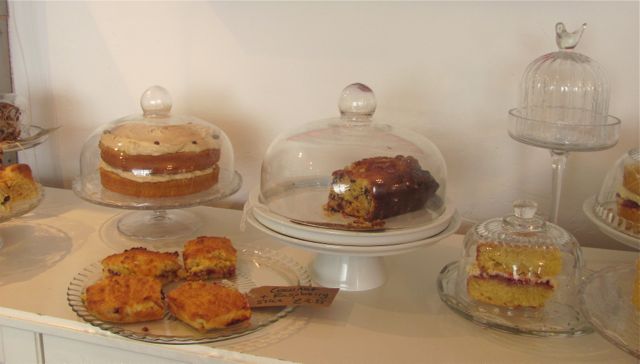
cakes at Freya'sEvery time I go in I’m reminded of Rick’s Cafe in Casablanca.

OK, Rick’s featured a casino and not cake. And it’s not the gambling, the diamond dealing, the Nazis or Bogart in a tuxedo, either: it’s the fact that everyone ends up here. As Rene says in the film, ‘Everybody comes to Rick’s’. I have seldom been in the Llew Glas and not known anybody there, but it’s not just a local haunt – some friends of mine popped in recently, complete strangers to the area, and were made to feel just as much part of the scene.

I came up with several pointers for a decent coffee shop in that earlier post – good coffee, good alternatives, good food and good service were, predictably, my top four (the others were a little more, um, idiosyncratic, including a complete absence of religious quotes and seats you can actually sit on).

The Llew Glas wins on all those; the coffee is good, as are the non-coffs, the herb tea (me), the hot chocolate (not for lactose-intolerant moi but for almost all of my friends). The food is great. There are light lunches – soups, sandwiches, a choice of scrumptious quiches – which are freshly cooked and not bought in, as well as the usual staples of gorgeous cakes and, as the sign outside says, ‘probably the best scones in Harlech’.

But for me it’s the service which shines out. An Irish friend of mine used to do a splendid act as a waitress in a newly-flash, Celtic Tiger, Dublin eaterie. She slouched up, got too close, sniffed juicily and then said, loudly and in tones of deep boredom, ‘y’aright?’. Once upon a time service like this was the norm; customers were a nuisance who got in the way. Unfortunately there are some places which haven’t realised that times have changed (another friend of mine was asked recently whether he could ‘take down’ the – accurate – reports of bad service which a restaurant had received on TripAdvisor, and was berated when he explained that this was impossible). But fake, we’re-afraid-of-TripAdvisor, service is one thing. Genuinely good service is another, and that is what you get at the Llew Glas.

Many years ago, some friends and I had a drunken conversation about something that was missing in Harlech. There were pubs (two, then, in the upper town) and a couple of very traditional cafés, but we didn’t feel that they catered for us or our friends. A wine bar was our conclusion, then. The main reason we felt we needed one was that it would provide a place for us to socialise without going to one of the pubs – no reflection on them, but they were quite a male preserve. To an extent, and a very considerable extent, the Llew Glas has filled this niche – and it’s a tribute to how good it is that it has done so without selling alcohol or being open in the evenings. After all, ‘everybody comes to Rick’s’ or, in this case, Freya’s…

harlech castleDetails? Well, the Llew Glas Delicatessen is at 3, Plas y Goits, Harlech – just opposite the Plas restaurant, in what is often known as Blue Lion (Llew Glas) Courtyard.

It’s open 10-5, Monday to Saturday; Sundays in the season, and if there’s only one piece of raspberry and coconut slice left, you won’t like it. Honest. Leave it.

Pre-ferment bread perfection

This blog shouldn’t, strictly speaking, be called ‘twelve miles from a lemon’. Things have moved on since Sydney Smith’s day, and I’m about 500 metres from a lemon (about 3 metres if you count the ones in the fridge). No, strictly speaking it should be ‘fifty-five miles or several clicks and an interminable wait for the postie from fresh yeast’. Gripping, huh?

Yup, I ran out.

I’ve ordered some now, of course, but in the meantime I had to find a solution to my immediate bread-free problem that didn’t either involve buying boiled baby’s blankets from the Co-op, waiting a few days to revive my sourdough starter or purchasing some dried yeast which would get used once and languish in the back of the cupboard until I threw it out. I’ve been corrupted, you see, by the delights of using fresh yeast. Unfortunately it can be a pig to get.

But I remembered a friend of mine, a man who has recently returned to breadmaking, telling me about his overnight pre-ferment which used very little yeast. There were some broken bits in the container, and I weighed them out – about 5g.

So I set to. And it worked, and it worked WONDERFULLY. I make no apologies for the sudden appearance of caps; the end result justifies them. In fact, I may take to pre-fermenting my bread on a regular basis. It’s a version of the sponge method, for any other bread nuts out there.

This is what I did. And thanks, Jon!

Basic bread – with an overnight pre-ferment
Makes one large loaf

pre-ferment 1For the pre-ferment:
100g wholemeal flour
250g strong white flour
a small pinch of sugar
5g fresh yeast – a teaspoon, roughly
425ml tepid water

Mix the flours and sugar together in a large bowl. Put the yeast in a jug with the water and stir until it is blended in, then add the liquid to the flour. Stir until you have something that looks attractively like wallpaper paste. Ignore its appearance, cover the bowl with cling film and pop it in the fridge overnight.

pre-ferment 2You might think this would kill the yeasts, but no; the following morning there should be plenty of bubble action going on. Take the bowl out of the fridge and allow it to come up to room temperature.

Now for the rest of the process.

350g strong white flour
1.5 tsp salt

Mix the flour and salt together in a bowl, then add the bubbly pre-ferment. Stir everything together well, using a spoon at first if you don’t want to get too messy but hands are easier. When the mixture has begun to come together as a dough, tip it out onto a lightly floured work surface.

Start kneading, firmly pushing the dough away, bringing it back towards you and turning it as you go, and do so for 10 minutes; I set a timer or I give up too early. The texture of the dough will change – it starts to feel silky – and it should become much warmer to the touch.  Roll it into a ball, put it in a large bowl and cover with cling film. Set it aside to prove (aka rise) for about an hour or so, until approximately doubled in size.

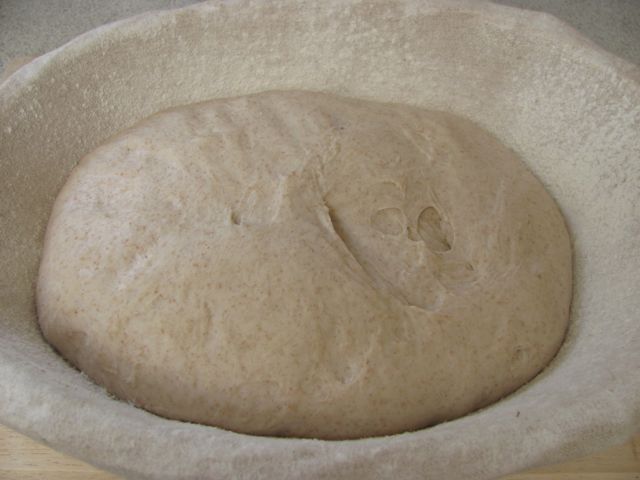
dough in bannetonThen take the dough out of the bowl and knead it lightly once more, shaping it into a round ball (or in my case, a sort of oval ball; perhaps I was influenced in my choice by the rugby that was going on at the time).

I use French bannetons – linen-lined proving baskets which are old, well floured and were dirt cheap in Carrefour – for the next stage, but the bread can also be put into an oiled and floured tin. (Personally, I find it spreads a bit much sideways if I just put it on a baking sheet, but I am the Queen of Sloppy Dough.)

Put the dough in the basket (or whatever), untidy side uppermost. Cover it with a clear plastic bag, pulling the bag up so there is no danger of the rising dough touching the bag.*

banneton 2Leave it in a warm place to rise until doubled in size again. This may take less time, possibly about 45 minutes. In the meanwhile preheat the oven to at least 220 degrees C, GM7 – you want it as hot as you can get it, really.

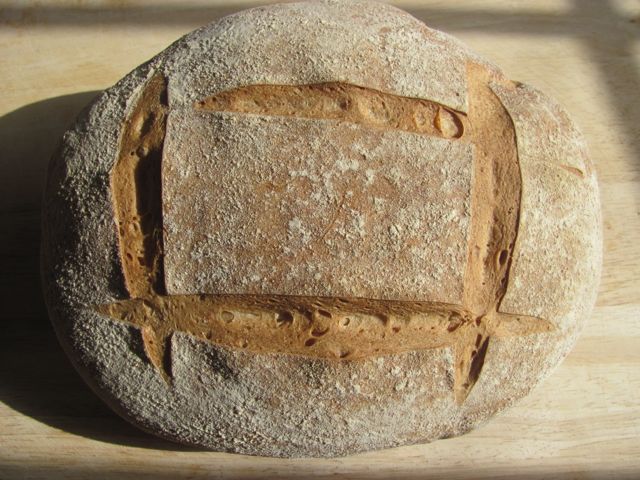
Put a lightly-oiled baking tray over the top of the basket and turn it over, carefully holding the basket in place; the dough will drop down and the basket can be easily lifted off. Slash the loaf three or four times with a really sharp knife – a sharp bread knife is good, or a purpose-made blade known as a lame or grignette – and put it in the oven quickly.

bread yumBake for 30-35 minutes – until the base sounds hollow when rapped, and the top looks golden-brown and delicious.

Cool the loaf on a rack, and resist the temptation to eat the lot. Like all loaves, it slices more easily the following day, but it did have to be sampled yesterday. Especially the crust. With raspberry jam. Might have been poisoned or tasted vile. You never know…This was, after all, an experiment.

And?

Well, I have to say that I found this loaf every bit as good as my normal loaf – in fact, possibly even more flavoursome. And, of course, it is much more economical with the yeast, certainly something to consider when the fresh stuff can be so fiddly to obtain.

bread

Note:
I love Bakery Bits for potential supplies – but it’s not cheap and I tend to use it for drooling and idle speculation. On the other hand, if I find myself in a perfectly ordinary French supermarket I automatically head for the homewares section. I’ve found round bannetons, long bannetons, oval bannetons – and all linen-lined and costing a fraction of what I’d pay online or in a posh kitchen supplies shop. Sometimes they are evidently intended to have a decorative purpose, but even those which lurk among the cushions and tablecloths are usually perfectly practical. And are just a few euros.

*Plastic bag + sticky dough = unbelieveable mess. Ectoplasm. Something from Withnail’s sink – matter. Worse. Ergh.

Beautiful breakfast

There was a time when I didn’t eat breakfast… or so I said. What I did, of course, was not eat breakfast at home. Instead I would grab the early train, nip into a coffee bar by Farringdon Station, order a coffee, open my laptop and then find myself back at the counter ordering something like a croissant. Or maybe two.

But I’ve changed. It was self-employment that did it, even before I came to my senses (insight © my mother) and left London. I used to go for a swim early every morning instead of standing at the station trying not to make eye contact with anyone. When I came back I was so hungry I would eat the kitchen – and I mean the units, not merely the contents of the fridge. The only way of preventing tooth marks on the fixtures and fittings was to make sure there was something ready for me when I got back. I experimented with all sorts of cereals, porridge with and without salt / jam / sultanas, types of toast, condiments – but I never really solved the problem. So many of the packet cereals – whether they were gritty and brown or mainstream and quite sweet – seemed rather dusty. Cardboard, with dried fruit.

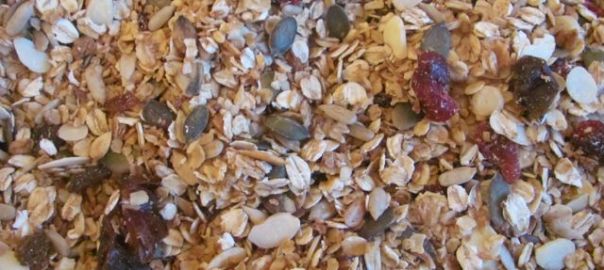
granola 1Then I moved here, and a friend passed on a recipe for a homemade morning – and a late evening after meeting friends in the pub – solution: a granola. I’ve made several versions since then, riffs on the theme, and have finally settled on an adaptation which I particularly enjoy. I’ve also added weights and rewritten some of the instructions, which originally included such highlights as ‘watch the pan while galaxies form and reform…’.

I make a huge quantity, and last week I ran out. Time to load up again at the wholefood co-op and find the biggest bowl in existence. And by talking to someone in the co-op I’ve found the answer to a question which baffled me but probably nobody else: the difference between muesli and granola. Muesli is uncooked and uses no fat; granola is toasted in the oven, and uses a little. Commercial granolas tend to use quite a bit; mine doesn’t.

Gorgeous granola
Makes a giant vat. I store it in a plastic box which takes 4kg of flour.

500g porridge oats
500g jumbo oats (used in two stages)
150g dessicated coconut
150g sunflower seeds
150g pumpkin seeds
75g set honey
1 tsp malt extract
100ml sunflower oil
100g flaked almonds
150g sultanas
100g dried cranberries
100g dates, chopped

Preheat the oven to 160 degrees fan, 180 conventional (but watch for a heated element at the top – may need to adjust settings to avoid this getting too hot and burning the granola) or GM 4. Take a ginormous bowl and put in the porridge oats, 400g of the jumbo oats (set the rest aside), the coconut, sunflower seeds and pumpkin seeds.

Put the honey – best measured by putting the full jar on the scales and spooning out honey until it weighs 75g less than it did – in a non-stick pan together with the malt extract. Then add the sunflower oil. Put the pan over a medium heat and melt everything together. As it reaches boiling point it will foam and rise up the pan (or alternatively start to look like galaxies forming); take the pan off the heat immediately and pour the contents into the bowl. Mix everything together thoroughly, breaking up any clumps that form.

When everything is combined, empty the mixture into some baking dishes. I generally use glass – Pyrex – ones; earthenware takes a little longer and metal roasting tins – tempting when you look at the sheer quantity – are unsuitable. Believe me #1. Don’t fill the dishes completely; you want to be able to turn the granola over and around to ensure it all toasts, and that’s difficult if you’re worried about spilling half of it on the oven floor. Believe me #2.

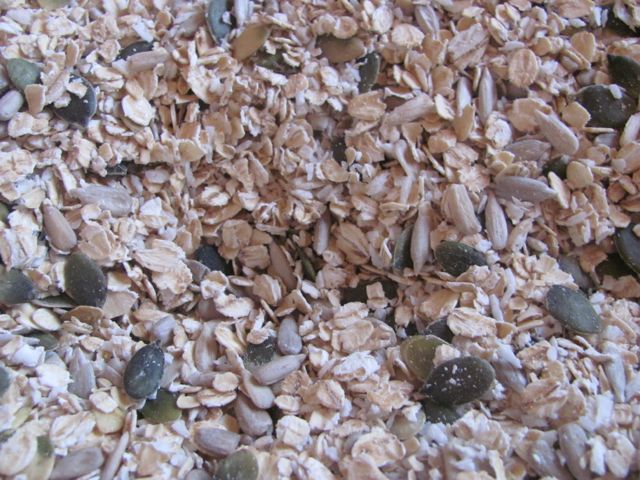
granola 2Bake the granola in the oven for 10-15 minutes, or until the top is starting to brown. Then take the dishes out of the oven and stir them well, bringing untoasted grains to the top. Replace them in the oven and repeat the process until all the granola is golden brown and toasty, but not remotely burnt. Warning: it speeds up towards the end and will need checking more regularly. Believe me #3.

Empty the contents of the baking dishes back into the bowl and allow the mixture to cool down completely, possibly overnight.

Considerably later or the next day, put a large dry frying pan on a medium heat and roast the flaked almonds, shaking the pan and stirring as they warm up. When they are evenly light brown in colour and beginning to smell warm and toasty, empty them into the granola bowl. Scatter in the sultanas and cranberries, then chop the dates and add them too, along with the remaining 100g of jumbo oats. Stir everything together again and put the mixture into its storage container. Hide container.

It’s delicious with yoghurt…

granloa 3One of the main reasons I love this is its sheer adaptability; the recipe above is what I prefer, but you can make it truly individual to suit personal preferences.

Adaptations I’ve tried include adding 100g each of hazelnuts and chopped brazil nuts before cooking; adding chopped dried apricots and figs after cooking; adding flaked coconut at that stage too, as well as the dessicated coconut earlier; adding sesame seeds with the other seeds (not particularly good – too small). Just one word of warning – it’s easy to make it too cloyingly sweet, and treacle and/or golden syrup: no. Or at least that’s a no as far as I’m concerned. Thank heavens I only made a smaller quantity that time!

Cooking the books

I admit it, I have an addiction problem. Cookery books.

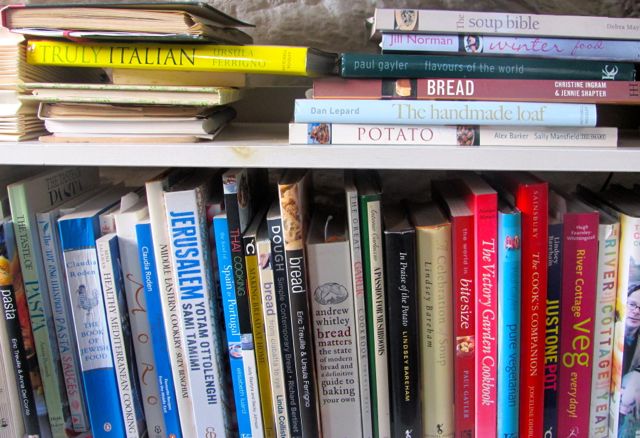
booksI like to excuse my terrible tendency to amass great heaps of recipe books (let’s not get onto the ones about the history of food, health aspects of food, ethnography of food, politics of food, even archaeology of food) as being work, so it’s OK. Honest.

As a writer and editor I’ve often worked on food books, whether as the writer, the editor, the copyed, the recipe writer or even the recipe sense-maker. The latter is a special category, incorporating all those who work with Big Cheese Chefs, attempting to make their recipes both affordable (‘Do you have to use a cut of meat that costs £150 and fifteen truffles?’) and workable in a domestic kitchen (‘Most ordinary kitchens do not have blast chillers and three ovens,’ or ‘Can we reduce the serving size from fifty?’). It also comes in useful when dietitians are involved – ‘I think most people might have difficulty measuring 73.8g of flour…’

Living where I do in deepest Snowdonia, there are some things I cannot get exactly when I want them, and one of them is a good Chinese meal. There are some good restaurants, but there isn’t anything really worthwhile under an hour’s drive away and in the present weather – hurricane, anyone? – that’s not really an option. Anyway it hardly qualifies as an impulse if you have to make sure the car’s filled up and then drive halfway over the mountains to get there. My collection of books on Chinese cooking are a little tired, so I ordered everything recent which the library had in stock and settled down for a little experimentation. They’re a mixed bag, and I’m not going to name names because I honestly cannot recommend any of the ones I tried.

What I can do, however, is have a chunter in more general terms. Because so much of my work as a freelance involves working with food books, I am an exceptionally fussy customer. Or am I?

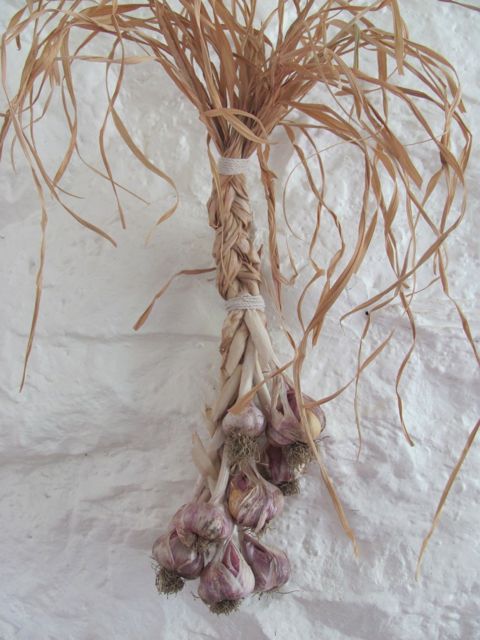
garlicFor example, I don’t think it’s asking too much to expect that a photograph which supposedly illustrates a recipe should actually illustrate  the recipe and not include things which aren’t in the ingredients – such as the chillies and carrots in one I tried, for instance. I know why the stylist put them in, though.

I’ve worked with stylists but it’s not that which gives me the understanding, it’s the fact that the dish, when prepared as given, was beige. Beige with a hintette of green, but essentially beige. Lumpy and beige. Very beige. What a strange word that is when you type it repeatedly, and what a bland and boring dish it would have been to photograph. Quick, sling some chillies on top; nope, that’s not enough – shove some carrots in…

I do tend to feel that if you want to use a photo but can’t illustrate the recipe for whatever reason – seasonality perhaps – then you should use a generic pic. Like the garlic above which has nothing to do, directly, with the text around it. Or you could leave it unillustrated, but that’s not always an option.

My next grumble, one which almost everyone will have experienced at some time but which seems to be becoming more and more common and was certainly present in my Chinese books, is the editing. Not even the editing, really – more the proofreading: ingredients in the method which aren’t in the ingredients list; ingredients in the list which aren’t in the method. Many’s the time I’ve been left standing in the middle of the kitchen shouting at a book (like it could answer) ‘All right, what the **** do I do with all this spinach?’ or ‘What tomatoes?’

I know why this happens. In simple terms, it’s the money.

Editors are not particularly well paid, and proofreaders are paid even less (contrary to the small ads for proofreading courses in the back pages of the Guardian), but even so it’s seen by some publishers – not all, I stress – as an area where economies can be made. And food editors / proofreaders do have certain skills which more general ones do not. Some are a bit specialist (will the recipe, as written, actually work – ‘Yes, I know it’s allegedly tested, but if I add X and then do Y it will curdle, so I doubt it’), and some are not. I once had a chat, for example, with a starting-out proofreader who had been asked to proof a recipe book – very cheaply – and who didn’t realise that the order of the ingredients in the list should always match the order in which they appear in the method.

Then there’s the fact that editing and proofing plain text is much more straightforward – hah, generally, ironic laugh – than working on recipes. Publishers often ask for a ‘normal’ book to be copy-edited at, say, ten pages an hour. With recipes, that comes right down – three recipes, depending on length and complexity, is an average per hour. (Particularly when you have to keep going back to the author with truffle-elimination and serving-size-reduction queries.)

Sometimes – and I’ve worked on both sides of the counter, as it were, so I know what goes on – a stage is eliminated: a copy-editor will be used as a proofreader or vice versa, or someone in-house will do both. The former is just about acceptable, though it depends on the extent of the copy-editing: you can’t spot mistakes or logical leaps in your own work as easily as someone who is new to it, so a proofreader is vital if a copy-editor has had to do a lot of rewriting. But a proofreader is not automatically a substitute for a copy-editor, who is generally expected to take a more wide-ranging view and occasionally rewrite huge chunks. Copy editors turn sow’s ears into silk purses; proofreaders make sure the stitching on the purse is right. They’re different skills. Or they are sometimes.

But it does have to be said that some books (and some publishers) are much more reliable than others, and that it’s always been an issue to some extent. One of my favourite titles, Claudia Roden’s Mediterranean Cookery from 1987, is covered in graffiti – things like ‘half qty fine’ and ‘WHERE DOES THE AUBERGINE GO??????’. When M&S published books under their own name, they were meticulous – everything not only got checked and double-checked by the publisher producing the book for them, but was checked again by their own proofreaders, and then went out for testing by their staff (don’t get me going on recipe testing; I’ll save that rant for later). So an old M&S recipe book might be boring – though that’s by no means a given; their French Country Cooking, for instance, is fab – but boy would those recipes work.

And the photos matched.

Now I must go and see if adding chillies to by beige mountain will help at all. I suspect not, but maybe that stylist was onto something…

Even more on the soup front

I am so glad that I made up a load of chicken stock, and that I firmly believe that a freezer without soup in it is just an unreasonably cold box full of the re-useable remains of natural dyeing sessions (that’s just me, possibly). Toothache turned into agony and agony turned into a removed wisdom tooth, and all I could manage for several days was soup. Soup and yoghurt. The latter got boring. The former, happily, did not.

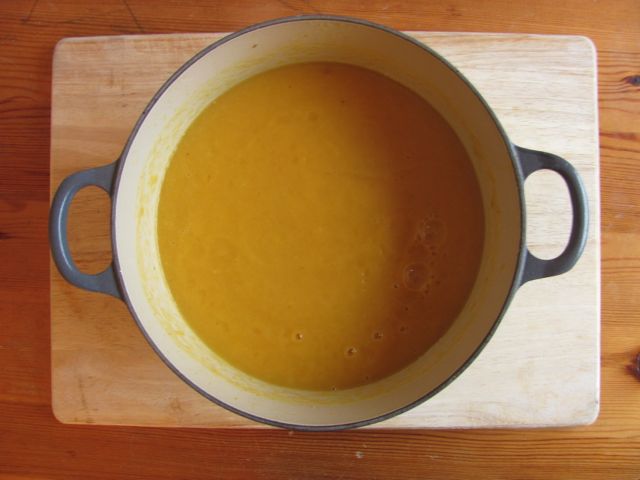
carrot soupSo here are my two soups made at the same time as my stock, soups which gave me the left-overs to transform into stock and which stopped me starving to death in the last week. Exaggerate, moi???

The first is a spicy riff on carrot soup. I often make it, because carrots are frequently such good value, and – of course – because I love them. I’ve recently made a classic carrot soup, carrot with ginger, carrot with a little lemon, carrot with fresh coriander, carrot with chicken, carrot with – well, you get the picture. But carrot soups can sometimes be rather – not bland, exactly, but perhaps less warming than I wanted this time. So I set to work to tweak my basic recipe, and I do like the end result.

Carrot, coriander and cumin soup
serves 3-4, depending on consistency

I large onion, chopped
1 tsp vegetable oil (often rapeseed – check ingredients and go for it if it is)
a scrape of butter
1 large stick of celery, chopped
2 cloves of garlic, finely chopped
2 small potatoes
500g carrots, chopped
1 tsp coriander seeds, ground
half tsp cumin seeds, ground
200ml chicken stock
750ml liquid (water or vegetable stock)

Put a large pan over a gentle heat. Soften the onion in the oil and butter, keeping the lid on so that it doesn’t colour. Cook until transparent – about 5-10 minutes. Then take the lid off and allow the onion to colour a little for a minute, and add the celery and garlic. Peel the potatoes, chop them up and add them too. Lower the heat, add the carrots and the spices and stir everything together. Put the lid back on and cook for a further 10 minutes or so – check during this time to make sure that nothing is catching; the potato is particularly susceptible.

Add the chicken stock and cook for another 5 minutes, then add liquid to cover. Bring to the boil, then knock back the heat and cook for a further 10 minutes or so, until everything is soft and the liquid is much reduced. Blend the soup and add some more liquid to get the preferred consistency. Reheat, season and serve.

soup2And now for soup 2.

This second soup is based on one of Hugh Fearnley-Whittingstall’s recipes – but heavily adapted to suit me and what I had in the cupboards (there was no way I was going anywhere other than the dentist with a face like a football).

I used to put pulses in my soups a lot but have recently fallen out of the habit; I don’t know why. I think I’m back in it now!

Leek and bean soup
serves 3 hungry people

3 leeks
1 tsp olive oil
a scrape of butter – about half a tsp
a sprig of thyme
1 bay leaf
1 x 400g tin of flageolet beans (haricot beans can be used instead, or any white bean)
2 dried chillies, seeds shaken out
a pinch of dried herbes de Provence
100ml chicken stock
2 tsp tomato purée
water to cover

Trim the leeks, slice them lengthways and then chop them. Put them in a large bowl of water and sloosh them about to shake off any soil. Warm the oil and butter in a pan. Lift the leeks out of the water with a slotted spoon and add them to the pan, then add the leaves from the thyme and the bay leaf. Put the lid on the pan and cook the leeks down for about 5 minutes. Drain the tin of beans and chop the dried chillies finely.

Add the beans and chilli to the pan, then add a pinch of herbes de Provence as well. Stir everything together and add the chicken stock; then add the tomato purée and water to cover. Increase the heat and simmer the soup until everything is tender. This should not take long but if it seems a little thin, increase the heat again and cook some of the liquid off. Check for seasoning and serve.

Now I’m dreaming of what I will eat when I’m able. Bacon sandwich!

In praise of stock

It’s often said that good stock is the basis of good soup – and stews, and risottos, and many other things I love making, and so it is. But I’ve battled with finding a decent one. Oh, apart from Marigold’s vegetable bouillon – and even that is a bit salty for me (I don’t care for taste of the reduced salt version). In my past life, I used to bring stock cubes back from France, but that’s no longer a realistic option and, let’s be honest, it was a bit daft even when I was using the Eurostar as an extension to the Northern Line.

Recently all sorts of stock options have become available, even in my local supermarkets, but I’m still not thrilled. There are fresh stocks, coming in at about £2-3 for 300-500 ml; fresh gels at roughly the same price for a smaller quantity, but they’re more concentrated; improved cubes – I don’t really need to make my own, do I? Oh yes I do:  how appealing does this lot sound?

‘Water, Glucose Syrup, Salt, Sugar, Flavourings, Lower Sodium Natural Mineral Salt*, Yeast Extract, Chicken Fat (2.1%), Carrots, Vegetable Fat, Leek, Parsley, Gelling Agents (Xanthan Gum, Locust Bean Gum), Garlic, Chicken Powder (0.2%), Colours (Plain Caramel, Mixed Carotenes), Maltodextrin, Carrot Juice Concentrate, *Contains naturally occurring Potassium’.

That’s, by the way, a chicken stock gel, but probably the 2.1% of chicken fat and the chicken powder (???) gave the game away. And why the need for four forms of sugar: glucose syrup, sugar, caramel and maltodextrin? AND, and, and, remember the rule of ingredients lists – they’re in quantity order. So there’s more glucose syrup, salt and sugar than chicken or vegetables. Hm. Think I’ll make my own.

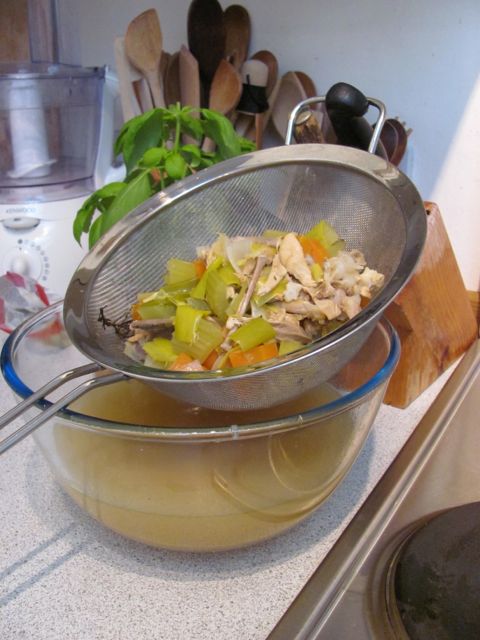
stock remainsBut doesn’t it take ages? That was my objection before I started, and I soon discovered that though it is a long process – and one that can be, er, fragrant – it can easily be fitted around anything else I’m doing, because 99% of the time I can just leave it to do its thing.

Another objection was that I might not have enough bits and pieces and I didn’t want to end up buying things specifically for stock – after all, part of the aim was to be economical as well avoid the chicken powder, locust bean gum and maltodextrin I didn’t particularly want to add.

That was easily addressed.

I like a roast chicken, but I love a good one. So I pay decent money and don’t have roast chicken all the time. That’s my choice, and it means that I use flavour-packed, healthy chicken. It would be criminal to throw out the remains, but one chicken isn’t enough for a decent quantity of stock – so I pick over the carcass, get rid of as much fat and skin as possible (the birds love it), and freeze the bones until I have enough.

And then I make my stock, often combining making it with cooking something else like a carrot soup which will give me other left-overs: carrot peelings, the ends of celery sticks and leeks. OK, the remains can look like something rather unpleasant, but the stock – wow, the stock.

So here goes. This isn’t an organised recipe, really, but it is seriously worth trying – and I’ll follow it in the next posts with a couple more soups I made with the start of the stock ingredients.

Chicken stock

A heap of chicken bones, the result of two or three roasts, picked over and frozen
Ditto of carrot peelings (wash the carrots first) and ends
Ditto leek – also carefully washed – or you can use an onion instead
Ditto celery…
Water

And that’s it. I might add some parsley from the garden in summer, or maybe a sprig of thyme in winter – but I go easy on the additions because they can become emphatic when frozen, and this stock is going to be frozen. That’s also why I don’t add any seasoning; the dishes eventually containing the stock can be seasoned when they’re being cooked.

I put the vegetables and the frozen chicken bones in a large casserole, cover them well with lots of water and stick the casserole on the hob. I bring it to the boil and then leave it simmering for a couple of hours over a really low heat. Of course it could go in a stove or indeed on one – I’ve a friend who simmers her stock casserole on her woodburner, but that assumes the existence of a woodburning stove with enough room above it for a casserole and a family who don’t mind the smell, because there’s no doubt that boiling up bones does smell. Not offensively, or at least I don’t find it offensive – just, um, unappealing. I don’t skim my stock at this stage; if I’ve done a good enough job of picking over the bones and washing the veg, I find I don’t need to. Then I go and do something more interesting.

When I go back, the veg are all soft and the meat has fallen off the chicken bones. This is the draining stage and is when the debris looks truly horrible. I get a large bowl and a large sieve, a bigger sieve than I think I need since my first attempt which left boiled bones on the floor, and empty the casserole into the sieve. I prop the sieve above the bowl on a couple of jars and just let it drain while I go away and – you guessed it – do something more interesting.

Then I remember, possibly an hour or so later, and give the sieve a final shake. (All the bits go in the food recycling bin; I don’t put cooked stuff or bones in my compost bins.) The bowl – now full of cold stock – is covered with cling film and put in the fridge overnight.

My fridge is cold (and quite new – my old one got tropical, ahem, but I’m more careful now) and when I take the bowl out the following morning, a layer of fat has formed on top. If I’m very careful lifting the bowl I can manage not to disturb it, and it’s consequently quite easy to remove. Then I pot up the stock into freezer containers. I use a ladle which holds 100ml comfortably, so I know that a freezer box has, say, 300ml in it. But I also fill little 100ml tubs, which are phenomenally useful. And tasty.

(Of course, the long, slow cooking that stock requires can seem uneconomic, but I don’t make stock all the time and, when I do, I make shedloads – enough to keep me going for a couple of months at least. It’s so flavoursome that I don’t need to use a lot, which is why the 100ml tubs are so good. They give a dish a depth of flavour without overwhelming everything else. Right, I’m making carrot soup – where are those bones?)