All posts by Kate

Unknown's avatar

About Kate

Writer and editor, with an unhealthy (or rather healthy) obsession with food...

Dealing with The Great Apple Glut, II…

Last year was wonderful. We didn’t have a summer as such, except in March, and that was just at the wrong time. My apple trees flowered early in a bit of a panic, there were only a few bees about and, as a consequence, I had very few apples. This gave me a breathing space which I appreciated. But this year I’m back to normal. I’m not complaining; I’m just running out of ideas.

There were three old apple trees in this garden and, when I moved in, I thought they’d be too elderly to present much of a problem. Wrong.

One doesn’t do much. Another is a Cox, and the apples it produces are prolific but beloved of the birds. The third is un-be-lievable. We’re talking carrier bags. So far this year I’ve given away nine, and I’m not talking half-full bags either. I’m talking bags so full the handles give way. And we’re picky when we’re picking – anything chewed, nibbled or pecked gets thrown over the wall into the wildy bit next door. Then I’m faced with the problem of what to do with what remains. A lot get given away, though my picking companion has his own problem and I can’t offload give him any. Chutney gets made, of course, and crumbles. And I’m also very fond of an apple cake which always goes down well – even though it only uses about three…

The original recipe has been much adapted. It came from a Good Housekeeping book on wholefood cookery that was published in 1980, on appropriately brown and gritty paper. Mind you, the attitudes in the text are rather 1950s – readers are warned, for instance, not to have too many spicy foods like curries because they ‘may overload the system’, and are told that business lunches can be a problem ‘for the husband who eats so much at lunchtime that he cannot face the large meal his wife has cooked in the evening’.  Grr. Sisters may be doing it for themselves, but not men – or not in the 1980 world of Good Housekeeping, evidently. Also some of the recipes are, quite frankly, disgusting. What on earth would possess anyone to make ‘breakfast in a glass’ with coffee substitute (?) boiled up with milk, strained through a sieve, then blended with – wait for it – an egg and a teaspoon of honey. NOOO.
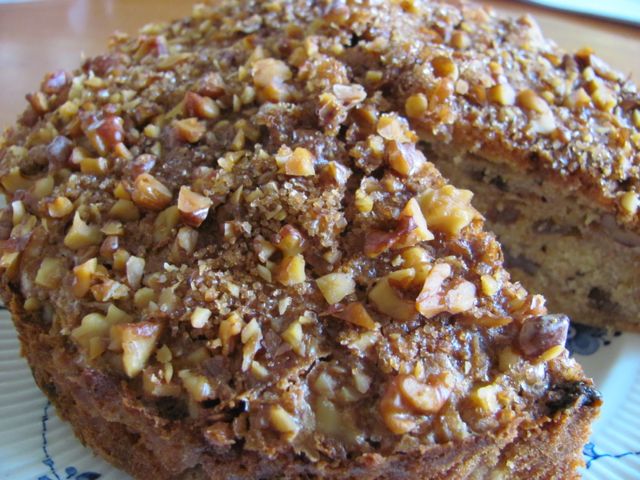
apple cakeHowever it is worth persisting, if only for the baking section. Perhaps not surprisingly, given that it’s a Good Housekeeping book, this is rather better and I have used a lot of the recipes in it. They are fine once I’ve worked on them a bit to make them less heavily penitential; there seems to have been some feeling that the proverbial reputation of wholefoods had to be maintained by producing worthy, weighty slabs of brownness. I find this odd, as by the 1980s even Cranks had begun to lighten up a little, both literally and metaphorically. So here is my heavily adapted, very heavily adapted – perhaps I should say ‘inspired by’ instead – contribution to coping with the apple glut, part two.

Apple and walnut cake

175g butter, soft
175g unrefined sugar
3 medium eggs
175g self-raising wholemeal flour (or 100g wholemeal and 75g white)
100g chopped walnuts
75g sultanas
half a tsp ground cinnamon
350g cooking apples (about three medium ones)
25g Demerara sugar

Preheat the oven to gas 4 / 180 degrees C (conventional; 160 fan). Grease and line a round 18 cm loose-bottomed cake tin.

Cream together the butter and sugar in a medium bowl. Then beat in the eggs, one at a time, and add a little flour with each one to help prevent curdling. Gently fold in the rest of the flour, half (50g) the chopped walnuts, all the sultanas and the cinnamon. Peel the apples and grate them straight into the bowl, folding them into the mixture one by one. It is easier to grate them if you leave the core intact for holding, then discard it afterwards. Spoon the mixture into the tin and level it out.

Put the rest of the walnuts on a chopping board and chop them even more finely using a large knife. Mix them with the Demerara sugar and sprinkle this crunchy topping evenly over the surface of the cake. Bake it in the oven for 90 minutes, then test to see whether it is cooked – a skewer or, if you’re me, a fine knitting needle, should come out clean – and you may find you need to leave it in the oven for another 10 minutes or so. When it’s done, take it out of the oven, put it on a wire rack and allow it to cool in the tin for at least 15 minutes before very carefully removing the tin – don’t turn the cake upside down to do this as some of the topping will fall off. Allow it to cool completely before serving.

A few tips to avoid unfortunate consequences (don’t ask me how I know):

1. This cake will not rise overmuch because of the topping, so do not be alarmed if the tin appears rather fuller than you might expect. Do not be tempted to transfer it to a larger tin. One word. Biscuit.

2. Even if you have another 67,945 carrier bags full of apples, do not be tempted to add more to the mix to see if it works. Err on the side of caution. Unless you like a sort of apply, slimy, slithery bread pudding, that is. I hate bread pudding. Any kind.

3. The cake mixture can seem a little heavier than you might expect. Do not be tempted to add liquid. See reason 2 above. The apples provide enough juice. Really.

4. Using dessert apples makes a sweeter cake, but it’s not supposed to be intensely sweet; it should have a slight tartness to it which is refreshing (according to some of the village garden club who have just tested one I made for an open garden event). Also eating apples can be too juicy. See reason 2 yet again.

5. I use the coarse half of a flat grater and rest it over the bowl; it works fine. The apples shouldn’t be too finely grated and if you do them in a food processor they can either go to mush or go brown, or both. Using the old-fashioned method doesn’t take long, works much better and doesn’t involve so much swearing (or washing up, come to that, for those of us who can’t have dishwashers because we rely on 200-year-old soakaways).

6. Depending on your oven, you might need to cover the cake with foil towards the end of cooking to prevent the top from catching. Only open the door to do this in the last 20 mins or so. Alternatively, cook the cake towards the bottom of the oven rather than in the middle. Especially if the unfamiliar oven you are using has an overhead element that cannot be turned off, unless you want a cold oven. Not a good experience.

All right, that used three apples. Hmm:
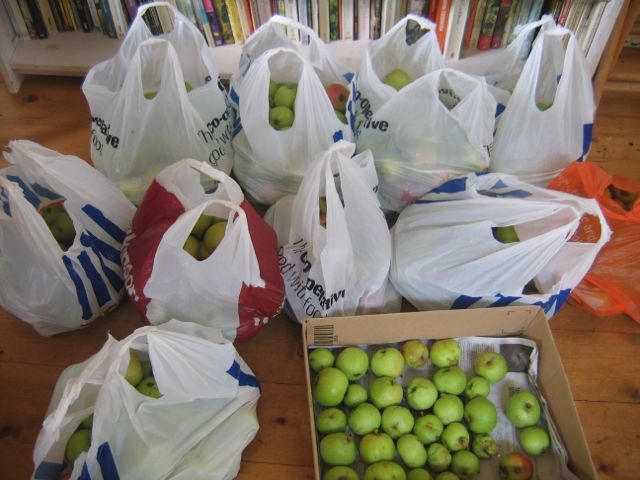
strewthRemember tip 2. Remember tip 2. Remember tip 2…

Really real seeds

I’ve always tried to grow at least some of my own food, even if that’s only been herbs in a window box. Now I grow much more, and last week I had a deep disappointment over beetroot, but at least they weren’t mine. I know that for some people the very existence of beetroot might be a deep disappointment, but I’m not one of them. I love beetroot, the earthy taste, the sharp fruity sweetness (if that’s possible), and most of all I love roasted beets chopped into a feta salad. Unfortunately I didn’t grow any myself this year – illness at planting time restricted my activity – and so when I saw some at the local produce market, I grabbed them. They were smaller than most, about the size of a golf ball, promising concentrated flavour.

Wrong. Texture, yes. Flavour? Nah.

You can grow things beautifully, with great care. You can harvest them when they should be tasty and succulent. But if you don’t have a good, tasty variety in the first place, what’s the point? And if you buy seed from the Big Boys your chances of getting a tasty end result are dimininshed. That’s because the Big Boys have to sell approved seed, and approved seed means commercial varieties. Varieties designed for the supermarket, by and large, where taste is not the first priority. Often the seeds on offer are F1 hybrids, so you can’t save the seed because they won’t come true, and they won’t have been bred to suit the domestic grower anyway. Oh, the copy on the packets or the in the catalogues may make them sound good, but stop a mo to consider what some of the wording means. ‘Good for freezing’ for instance, on a packet of French beans. All French beans are good for freezing. What this means in this context is that they’ve been designed (bred or engineered) to all ripen at the same time, which is what commercial growers need. Gardeners do not; we generally prefer our mad, insane, ripening season to be spread out a little bit, if only to ease the stress on our nerves and picking hands. Nor do most of us demand ‘good uniform fruit’ – another strap line – but supermarkets do. Flavour, they’re not so bothered about. And, almost inevitably, many adaptable and delicious (often local) strains of vegetables have been lost in the past 40 or 50 years.

This brings me to a company who are the first of my local food heroes. I’m stretching ‘local’ a bit here, but they are in Wales. South-west Wales, but Wales nonetheless: The Real Seed Catalogue. I try and order most of my seed from them, at least in the beginning – and that’s at their encouragement, because one of their aims, at the cost to their own profits, is to get people to save their own seed. So what’s different about them? That would be almost everything. They specialise in heirloom and heritage seeds, seeds for plants that have been shown to really work, seeds for plants that are packed with flavour.

kaleTake one example, Sutherland Kale. I first grew this a couple of years ago, and it’s a smasher. It’s also a perfect illustration of the philosophy behind Real Seeds. It’s a real heirloom variety, now thought to be extinct except for individual gardens – and the Real Seeds seedbank. It can withstand almost anything in my exposed garden (even cabbage whites, which have been hellish this year), and still perform. And it tastes great, so several ticks for this variety already. Then there’s how it came to be offered through Real Seeds, which illustrates the collaborative community they have built up. As the packet says: ‘This variety was saved for years by Elizabeth Woolcombe of West Drummie in Sutherland, who is now 93. She got it from a kale researcher [who knew there were such jobs?] called Angus Simmonds in the 1950s…’ and it was sent in by someone called V. Shilling. Not exactly a product of intensive development, then, designed to produce lots of kale for a giant supermarket distribution centre in, say, the third week of February. Maybe this year they’ll be adding Shetland Kale, as they have had seeds submitted for trial and it’s currently doing well. And they do trial; nothing gets in the catalogue or on the website unless it works. Everything is grown at their place in Pembrokeshire for family use; if it’s fiddly, fastidious or tasteless it doesn’t make the cut. But it’s not parochial; there’s a wide selection of oriental vegetables, for example, or tasty Bulgarian tomatoes alongside the more familiar Cosse Violette climbing beans and the Verde di Italia courgettes. And they all work.

Adaptability is vital; growing your own vegetables can be chancy enough without unconsciously trying to replicate commercially grown varieties. The small team at Real Seeds also make sure that they select the best seed in the first place, something most gardeners used to do but which is impossible on a highly commercial scale. They also continuously assess the range of seeds they offer, looking at areas which are a little light – runner beans, for instance, or endives – and deliberately going in search of appropriate possibilities. Some of the things they offer might be an acquired taste (I’m not quite sure why I ordered the cucumber I did one time, but let’s just say it didn’t make my cut, though some friends loved it), or completely unfamiliar – but I follow the advice of one of the River Cottage books and grow something unfamiliar every year. And I know that if I fancy growing huauzontle*, there’ll be decent seeds available, clear instructions and even a few recipes delivered with my seeds.

*A Mexican contribution, otherwise known as ‘Aztec greens’, Chenopodium berlandieri. Now you know…

Crumble time!

Almost everyone loves a pudding and now that the nights are getting cooler and mist is accumulating in the dune slacks overnight, it’s time for apple crumble.

Oh, enough with the ‘season of mists and mellow fruitfulness’ stuff. It’s time for apple crumble because my three ancient apple trees have gone into massive overproduction this year. People I know will soon be running away from me – if they stand still for five seconds I’ll be forcing them to take plastic bags filled with fruit, and they remember previous years. (Some have actually requested apples. They know not what they do. But they are about to find out.)

BlackberryAnd then there are the blackberries. The earliest are ready, fat and full of juice. I’ve some in my garden – they got missed in the Great Weeding – and only have to walk five minutes round the corner to get more. Blackberry and apple crumble is a traditional favourite, but I do get bored picking the seeds out of my teeth (ever the lady). I also think apple crumble can be a bit, er, basic – that’s fine, but I decided to come up with a more alcoholic adult version nonetheless.

I love playing with the concept of the crumble. I’ve done savoury ones; I’ve made the crumble from almonds and walnuts and oats and all sorts of other things; out of season I’ve crumbled whatever fruit is on special offer in Aldi; I’ve added interesting spices. But this one worked best when the topping was simple and traditional. Of course it’s good with crème fraiche or Greek yoghurt or double cream or ice cream or custard, but that’s not much help if you fall into the category – as I do – of the lactose intolerant. Hence the coulis. That and avoiding the whole seed/teeth/public embarrassment problem.

Apple crumble with blackberry coulis
(Serves 4, using a 20cm baking dish at least 5cm deep; a soufflé dish is ideal – but see below re servings…)

50g wholemeal flour
50g porridge oats
3 tbsp unrefined sugar
50g butter, chopped
half a tsp cinnamon
800g – 1kg cooking apples
2 tbsp Calvados or brandy
1 tbsp sugar

For the coulis
300g blackberries
a little water
2 heaped tsp vanilla sugar (according to taste – plain caster sugar can be used instead)

Make the coulis first. Rinse the blackberries to dislodge any wildlife and put them in a pan. Add a very little water – not even enough to cover them – and a teaspoon of the vanilla sugar. Bring to a simmer over a medium heat, stirring. Once the blackberries are soft and beginning to disintegrate, remove from the heat and mash them slightly. Then pass them through a sieve, preferably a nylon one, into a bowl – push as much pulp through as possible and discard what remains in the sieve. Pour the contents of the bowl into a non-stick pan – there will probably be about 300-400ml, depending on the juiciness of the blackberries. Taste the liquid and add another teaspoon of vanilla sugar if necessary. Bring the juice to the boil, stirring constantly, and reduce the liquid by half (don’t be tempted to walk away because it will boil over, quite suddenly, if you do). When it’s reduced, pour it into a jug and put it to one side to cool.

Then it’s time to make the crumble itself. There are two ways – by hand or in a food processor (I’m a recent convert to the latter). By hand, the butter should be warm; otherwise, cold from the fridge. Put the flour, oats, sugar, butter and cinnamon (if using) into a bowl or the food processor. If processing, pulse until all the ingredients are well mixed. If purist, gradually work the butter into the other ingredients with your hands until you have a fine crumb and all the butter is incorporated. Set the crumble to one side while you prepare the apples.

Preheat the oven to 180 degrees / 160 degrees fan / gas 4. Peel the apples, halve them and remove the cores, then chop them up and put them in the bottom of the baking dish, packing them down; they should come to within about 1.5cm of the top. Pour the Calvados over them, then scatter the sugar over the surface. Finally top with the crumble mixture, spreading it evenly over the surface and pressing it down with the back of the spoon. Bake the crumble in the oven for 45 minutes.

Serve – hot, warm or cold – with the gorgeous purple coulis poured over it. The coulis can be warmed up, but in practice it takes on a lot of warmth from a hot helping of crumble…

Sigh. OK, now I’m hungry.

Ah, yes, one final note – as I’ve discovered, this may well be enough to serve four – but if men are involved you may find it serves two, possibly three if you run, get there first and beat the competition off with a ladle. Hmm.

A tale of two coffee shops

We’ve got a new coffee shop. Admittedly, it’s part of a chain – it’s a Costa – and it’s also in the town ten miles away (TTMA, from now on), but it’s an exciting new development. Well, it is if you’re me,  and judging by how busy it is, I’m not the only one who thinks it’s an improvement. For one thing, their coffee doesn’t taste of old, charred, sock. So far.

Ten years ago, the choice of coffee in the TTMA was comparatively limited. There was, and is, a small department-ish store with a lovely café where you could get a decent coffee and, er, pay well for it. The food was good, too, but for me – well, it reminded me too much of Saturday shopping when I was a child. Doilies, tablecloths, lots of ladies of a ‘certain age’. Don’t get me wrong; I still go there sometimes – it’s delightful. But it also has the ability to make me want to leap on a table, shout something outrageous like ‘knickers!’ and run away. There was also a deceptive café with plastic seats where the coffee was great even if the ambiance was dodgy, and another place where your coffee (soooo burnt sock) came with biblical quotes. That was it. We’ve had additions since then, but none of them have quite managed to get it right – in my opinion – though there is a deli which does do great take-away coffee.

Caught by the rain, I ended up in one of the additions recently. It’s popular, but – and we are back to singed-sock coffee, by the way – it takes more to create a cool coffee-shop ambiance than slinging a couple of sofas in your window. Especially if you have neon lights and chairs that punters slither off when they relax too much. And – and this is today’s bugbear – if the (very young) staff are not adequately supervised. When serving in a not-that-busy coffee shop you do not a) forget about a customer’s order until they come back to the counter and remind you of it, and b) forget about it because you are too busy discussing some customers’ appearance with your colleagues, certain that you cannot be understood because you are speaking Welsh and it’s the weekend when there are lots of visitors about. Wrong, on so many levels. They did have the grace to go bright red when I deliberately chased my order in Welsh (fairly bad Welsh, but there was no way I was going to let them assume I didn’t understand what they were saying).

So I took to scoring local coffee shops – the only newspaper available to read was the Daily Mail, and the sea hadn’t frozen over so I had to find something else to do while the delicate aroma of footwear and employee embarrassment faded slightly. These were my assessment points:

* Good coffee. Oh, all right, drinkable coffee. But definitely no socky element.
* Good alternatives, especially tea – which should not be an afterthought.
* Good food, or maybe that should be decent food (let’s be realistic). Not, preferably, bought in.
* Helpful, attentive staff who keep their personal opinions to themselves. In any language.
* A relaxed atmosphere.
* Lighting which doesn’t make you feel like the Gestapo are hanging around outside.
* Seats you can sit on (there’s radical), and which may – shhh – actually be comfortable.
* A complete absence of religious quotes, though I might make an exception for some of the more, ahem, colourful parts of the Old Testament.
* Moderate pushchair count – so that there’s room for the non-pushchair-pushers to get to seats / counter / loo without injury. Not a complete absence – the ideal coffee shop should welcome everyone – but customers and staff do need to keep their limbs intact. Plus, blood can be difficult to get off any upholstery.
* Atmosphere. Character. Individuality. Not being a Starbucks. There. I’ve said the ‘S’ word.

The coffee shop I was in scored a 1 because it’s a religious-quote-free zone. Maybe a 1.5, because the food can be good, though it has let me down. OK, a max of 2, perhaps a 3 because it does have some individuality and isn’t part of a chain, but then the bible-citation place would score on that scale too (though that one compensates for the evangelizing by having generally good home baking and being safely veggie, should you need it).

Now, about the same distance from my house in the other direction is another small town. No chain coffee shops here. Here we have something as near to perfection as is theoretically possible on my scale, an independent coffee shop in an ex-ironmonger’s. I was interested to see how it would stack up.

THAtmosphere? Well, the old shop counters still remain, as does the shelving along the walls and the whole of the cashier’s office, which makes a great snug / pushchair corral. There’s lots of polished wood, a display of local crafts, some newspapers (and they do help – except when the only choice is the Daily That’s Outrageous and It’s Someone’s Fault, free wi-fi, and home-made cakes so decadent that they should be made illegal. There’s not the slightest hint of footwear in the coffee and there is an amazing choice of tea: Russian Caravan? Rose Puchong? Organic Orange Pekoe? Citrus Rooiboos? Strange compost-scented tisane? No problems.

The lighting is fine, the seats are fine (yes, there are sofas, but they’re at the back and not statement sofas in the windows), the staff are welcoming nine times out of ten – nobody’s perfect 100% of the time, but I’ve never yet caught them talking about their customers – and the pushchair tally is also acceptable. And there are no passages from any holy book whatsoever to distract you, either. I think they get a 10. Maybe a 9.5, because perfection is impossible. But I’m sure they’re working on it – and let’s hope Starbucks don’t notice, given their predatory behaviour towards successful coffee shops. I trust we’re ostensibly too remote…

Foraging the market

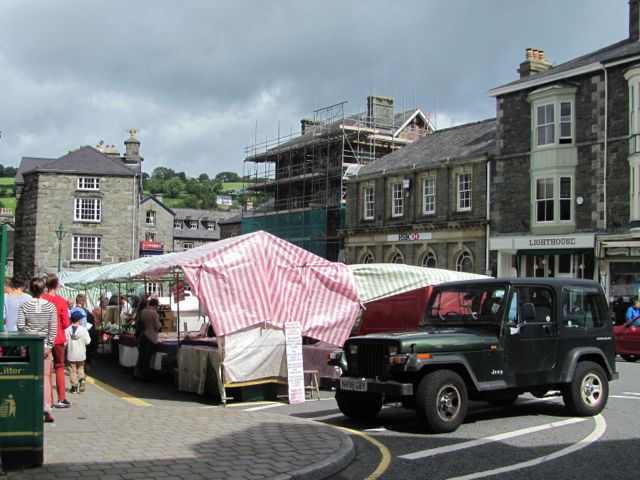
marketSunday saw the small but perfectly formed farmers’ market in Dolgellau and – by strange coincidence, ho ho – the gathering of our wool-spinning group, the Sunday Market Spinners. We’re a motley band but the first thing most of us do is hit the market; only then do we return to our woolly group and get on with nattering, fondling fibre and solving each others’ gardening dilemmas.

The market happens on the third Sunday of each month, except in January and February when the risk of frostbite is just too high. There are regulars selling everything from plants to vegetables, mutton to eggs, chocolate to goats’ cheeses, and the stallholders also usually include a beekeeper, a wonderful Kurdish baker and a smokery. Occasionally there are surprises, and they are really worth looking out for – and they are also one of the reasons why it’s a good idea to hit the market before hitting the spinning wheels.

On Sunday I had a shock while passing the Wildlife Trust’s stall. There, quietly and discreetly, partly sheltered behind some herb plants, were two tubs of chanterelles. giroles

I have a favourite foraging spot for chanterelles, but there haven’t been many this year – either that or the people staying on the nearby campsite have wised up – and even on a good year, supplies are limited. So stumbling upon these was wonderful: no clambering around in dripping woods, no sliding down muddy paths and dropping my finds in a stream, no unfortunate encounters with sylvan dog toilets. But I haven’t got a lot. So what to do with them? There aren’t enough for Antonio Carluccio’s wonderful cantarelli in salsina – with shallots and a simple creamy sauce – but I could serve them with pasta. Or I could mix them with other mushrooms, perhaps cook them off with onions, lemon juice and a little cayenne, serve on toasted sourdough. Nah – I’d miss the delicate taste, and I fancy my wild delights as the hero ingredients.

I know – girolles à la forestière. A traditional French recipe, adapted by Jane Grigson in Mushroom Feast and then by Roger Phillips in the wonderful (if patchily edited – missing ingredients, missing quantities) Wild Food. And I’ll have to adapt it again, heavily, to suit the fact that – strangely – I haven’t got a kilo and a half of the mushrooms and I also want to use less fat. However, it’s perfect for me because I have some good bacon to hand (we do excellent butchers round here)  and I’ve a great crop of potatoes, La Ratte – perfect for this recipe. In the event, my adaptation was even more significant because my chanterelles just didn’t give off the reported amount of liquid.

Girolles à la forestière – de ma façon
(serves 2)

250g chanterelles
250g new potatoes
1 tbsp olive oil or a sliver of butter
4 rashers of good back bacon, chopped into strips
a sprig of thyme
salt and black pepper

Carefully clean the chanterelles, brushing off any flecks of soil. Trim the ends of the stalks and chop any particularly large ones in half. Put the potatoes into a pan of cold water and bring it to the boil. Cook the potatoes until they are just done – test them while they are cooking and take them off the heat as soon as they are ready. Drain and set aside, then chop them into smaller pieces (to match the size of the chanterelles) as soon as they are cool enough to handle.

Put the oil in  a non-stick pan or large frying pan and cook the mushrooms over a medium heat for five minutes or so, stirring all the while, until they are just beginning to colour. Drain off any liquid and set the mushrooms aside. Increase the heat a little and put the bacon in the pan. Cook it for 5 minutes, until it too begins to colour and give off fat (if there is a lot, drain some of it off). Add the potatoes to the pan and  turn them over in the bacon fat. Allow them to brown a little, stirring again – this will probably take another 5 minutes – then return the chanterelles to the pan and scatter the leaves from the sprig of thyme over the potato, mushroom and bacon. Cook everything together for a couple more minutes, stirring, then season with salt and black pepper and serve immediately.

Serving: lovely with a green salad and a chunk of good bread. And a glass of something!

And now I need to get my boots and my stick and my basket. Because the man on the stall said there were lots of ceps around, and I think I know where he’s found them…

All change with ‘them purple things’…

Aubergines. Let me make that quite clear before anyone assumes anything else… this is a food blog, after all.

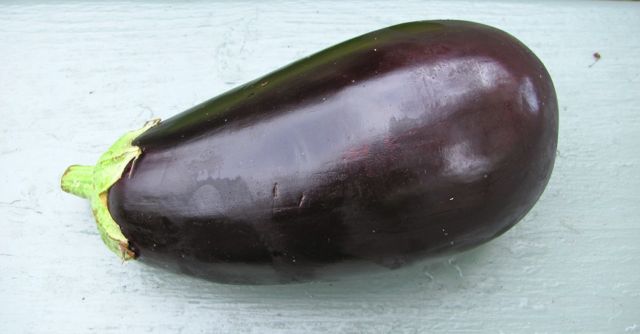
aubergineOnce upon a time It was almost impossible to get aubergines around here;  if I wanted to make ratatouille ten years ago I either had to grow my own or take a chance that a stray aubergine had escaped from captivity and sneaked onto the shelves at the local Co-op. There was no guarantee they’d be there – they were missing more often than not – and there was no guarantee they’d be in a decent condition if they were present. Ratatouille became an improvised treat, one organised on the hoof if aubergines were in stock, as did baba ganoush and any of a whole variety of smoked aubergine dips. When I saw them, I grabbed them.

The whole situation was summed up in a conversation my brother had when he was on a similar quest several years earlier. He had returned with his family to the North Yorkshire coast, had gone into one of the two local greengrocers (both – incidentally – very good, if what you wanted was ‘normal’ – quote). He looked around, didn’t see what he wanted:

Bro: ‘Have you got any aubergines?’
Girl behind till: ??? [Pause] ‘Do-REEN! Have we got any aubergines?’
Woman sticks head out of door at back. ‘Aubergines?’
Bro and GBT: ‘Yes.’
Doreen: ‘Are them them purple things?’
Bro: ‘Yes.’
Doreen: [Pause 2] ‘We had two of them but they went off.’

Today, by contrast, I wanted to make a ratatouille. The courgettes have gone a bit mad, possibly a swan song as they’ve also gone rather yellow, and I have to make lunch for a visiting friend. I had in mind a rather delicious ratatouille quiche, but I’d no ratatouille left in the freezer (it freezes so very well that some always ends up in there). So I took myself off to the Co-op, nice and early before all the holidaymakers filled up the car park, and bought my aubergine along with the rest of the shopping. And it’s a beauty, rotund and gleaming, in perfect condition. I also had my choice of peppers – unremarkable if you live in many places, but they were once also difficult to find in useable condition.

How very much things have changed in eleven years.

Then we had one branch of the Co-op, somewhat unreconstructed and five miles away, and another, even worse, ten miles in the other direction; they were my closest supermarkets. There was and still is a Spar in the village; there’s a great butcher but you wouldn’t want to rely on it for anything else. If I was in one of the towns – Bangor, perhaps, 30-odd miles away – or on a longer trip to, say, the bright lights of Llandudno, I would take a cool bag and make sure I popped into a bigger supermarket. I didn’t regard doing this as letting the side down because the Co-op let me down often enough, running out of exotica like bread and milk by 10 a.m.

Now? Well, while there isn’t the same selection that you’d get in a less remote area, things have improved vastly. And I do mean improved, despite the fact that one of the changes was the arrival of Tesco. It’s not an enormous branch, and I have had several arguments about its selection of goods (some used to appear during the summer season and then vanish – when I asked why once I was told ‘oh, the locals won’t buy things like that’; grr – I am ****** local and call me fussy but I actually wanted crème fraiche) it is a Tesco. To my delight this was shortly followed by both Lidl and Aldi and, even more to my delight, their presence seems to have revived, rather than killed, the local town. There’s even less of the holiday-season availability nonsense in Tesco, no doubt because when they come out with that sort of excuse you can pop round the corner and buy whatever outrageous thing you require in Aldi or Lidl. Yes, the Co-op closed soon after the trio arrived but it was often like being in a holiday airport in winter – empty and echoing, with a few people wandering about muttering to themselves. Probably about the fact that they were unable to buy bread.

Even better, it’s not just supermarkets. There were one or two local producers of particular things: Halen Mon, with their gorgeous sea salt; some cheesemakers and meat producers. Now there are many more. For instance, there are two excellent sources for local honey, several suppliers of delicious organic eggs, there’s a great chocolatier and even a mushroom farm, and obtaining mutton, great dry-cured bacon and a wonderful range of sausages is easy at one of the two local farmers’ markets. Yes, I still have a list for when I have to be in Bangor (Waitrose have opened a small but perfectly formed branch in Menai Bridge, plus the big Tesco there has many specialist ingredients I might need when editing and recipe testing), but now my list is full of the weird and wonderful rather than the basics. ‘Normal’ has been redefined, and not just in greengrocers.

Yeast Quest 2013

I bake my own bread. Well, sometimes I bake my own bread – most times, really, unless I’m unwell or in a frantic rush or have a broken freezer. I didn’t, once upon a time, and that was because I couldn’t. Really. I produced slabs which would have made good ballast and which even the birds rejected when they were thrown on the lawn (where they made a substantial dent). And then I finally got round to leaving London, eleven years ago.

While I lived down south, and while I had a respectable income – not excessive as I mostly worked in the book trade, just acceptable – I could afford to buy the bread I liked. Sourdoughs, perhaps; granary cobs crunchy with sunflower seed toppings; white loaves which didn’t taste of boiled baby’s blanket. There’s a place for the BBB loaf though – a bacon sandwich isn’t quite right without soft and slightly soggy bread – but it wasn’t right for my everyday life, which was what it looked like becoming. Getting those artisan breads was then next to impossible without a long drive, even had I not managed to halve my income.

I found a wholemeal loaf that wasn’t too bad, or so I thought. It would fail to go off even after a week which I found rather suspicious, but it didn’t leave a strange aftertaste or turn to putty when you ate it. And then I read the ingredients, and came face to face with the fact that I was going to have to do something. I’ve always held to the line that if you can’t pronounce the ingredients, then you shouldn’t be putting whatever it is in your mouth. So how about ‘mono- and di-acetyltartaric esters of mono- and di-glycerides of fatty acids’? They’re emulsifiers, basically, but… but…

I was going to have to learn to bake bread.

Financially, I had it planned. It would work out either cheaper or at roughly the same cost; I’d also have bread I liked and would be less likely to throw out for the birds. I’d my two freezers, I was part of a wholefood co-op and I knew someone who would be prepared to split a sack of flour with me. But practically? Hm. I was back with the awful reality of The Slabs. I told a friend of mine – a male friend of mine, an essential fact – that it was no good, I couldn’t bake bread. I’d just have to get to like E471, E481 and E920. (The latter is L-Cysteine, derived often from pork and also, sometimes, from hair – human hair, it has been alleged.)

My friend assumed an insufferable expression of masculine superiority and told me, in incredulous tones, that anyone could bake bread. He baked bread, for heaven’s sake. This of course, is all the incentive a self-respecting independent woman needs. Anything a man could do, I could do, and so there. And I did.

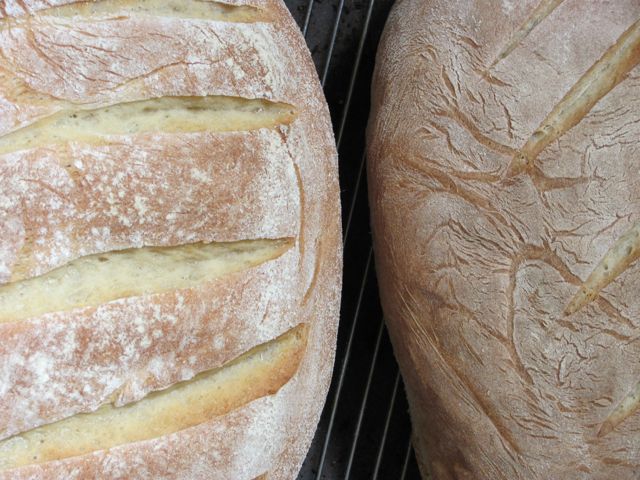
loavesMy breadmaking got better and better; I branched out from tin loaves to cobs and from using easy yeast to starters. I made olive bread and sunflower loaves and loaves containing sun-dried tomatoes. I made soda bread, pain de campagne and pitta; I made plaits and foccacia and San Francisco sourdough. I foreswore the E920, and used flour, salt, yeast and water. Sometimes I used olive oil; sometimes I used buttermilk.

And then I got hooked on real yeast. It’s no good, it just gives a different taste. It’s not that it’s difficult to use.

It’s difficult to find.

I swear it’s easier to score hard drugs (should you wish to do so, ahem). This is one problem I cannot ascribe to being ‘twelve miles from a lemon’, as it also besets foodie friends in London. Once upon a time bakers used real yeast and could be persuaded to sell some to members of the public, apparently. Not so now, though one friend has found a local bakery which will part with a little, reluctantly and at a surprising price. A hefty price for a small piece, barely enough to bake a single loaf, which they then dispense as though it was crack – secretly, furtively, behind the counter. Goodness gracious.

Surprisingly, a supermarket came to the rescue. Morrisons, but only Morrisons in Aberystwyth – 55 miles away, approximately. A keen baker friend had to go there regularly and would bring some back for both of us (50p for 126g), but circumstances have now changed and she’s no longer travelling south every week. You can get fresh yeast online, but supplies are erratic and you often have to buy a minimum of 400-500g. As 15g will do for 700g of flour, I don’t really need half a kilo.

In the short term, we’re sorted – you can freeze fresh yeast for a while, so we bought up Morrisons supply, cut the blocks up into individual portions, wrapped them up and shoved them in our freezers. But what happens when that’s all used up? Yeast Quest, that’s what. Again.