Monthly Archives: February 2015

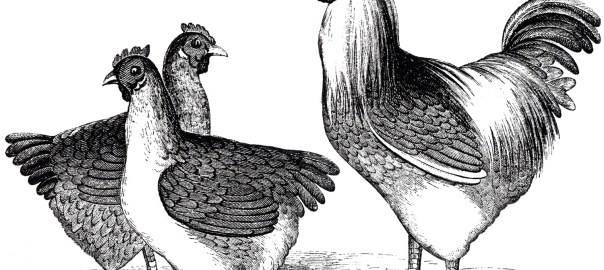
chickens for soup...

On comfort food and chicken soup

I have not been very well and, while I haven’t felt an awful lot like eating, it takes more than a nasty virus to stop me thinking about food.
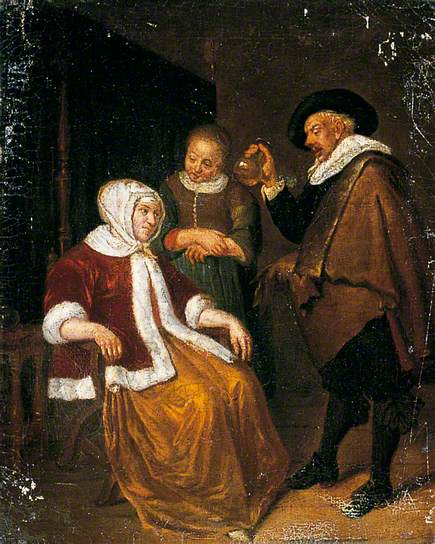
The Sick Lady(This is me. Oh, all right, it isn’t. I’m in jeans. And I’m not getting any sympathy at all.)

I have had a horrible cold, followed by bronchitis. OK, none of it’s very serious when compared to what some of my friends are going through, but it’s thoroughly unpleasant. And of course the infectious nature means I’m steering clear of people, particularly a couple of friends who are immuno-supressed at the mo.

I have been distracting myself with thoughts of comfort food. Not, until recently, eating that much of it, and I admit my interpretation might be a little eccentric: for some reason taramasalata doesn’t often crop up on lists of foods that make you feel better. I’ve been having a lot of mashed potato and chicken soup – not together, eeeugh – which is possibly unsurprising, as I clearly remember someone once describing mashed potato to me as the gentile equivalent of chicken soup. Comfort food. But chicken soup also does you good. Mashed potato? Not the same. Nobody ever called mashed potato ‘gentile penicillin’.

Chicken soup helps – and this is really true, backed up by some serious science which must have been fun to do if the researchers were allowed to taste – with colds and coughs. It is not a myth; it’s reality. It has anti-inflammatory properties. Yes, it improves hydration; yes, it helps your ‘nutritional balance’ – but, and more significantly, yes, it accelerates ‘mucosal clearance’. Perhaps doing the research wasn’t so pleasant after all…

chickens for soup...Over the years I’ve had a bash at all sorts of variations on the chicken soup theme, from great chunks of chicken in cock-a-leekie (yum) to home-made chicken stock in an avgolemono (also yum). Oh, yum to the lot of them – well, except from some rather bizarre-tasting tinned things, that is.

But when I talk to some of my friends about making chicken soup, the general consensus – and there are some very honourable exceptions – is that it’s too much faff. But it doesn’t have to be, unless you want to go into overdrive and Eastern-European shtetl-based stereotypes and boil up a raggedy old fowl for several hours first while playing the fiddle on a roof.

So here are a couple of simple chicken soup suggestions with some variations – written out generally as most of them are designed to be riffed on, as it were. And both of them involve the remains of a roast chicken (you can bake a couple of chicken thighs if the two-legged mice have been at your cold chicken while you weren’t looking). Both are designed to serve two, though they can easily be stretched further.

First, my simple roast chicken soup:
Strip all the meat from a roast chicken carcass; there are usually some pieces left over which nobody quite fancies. Remove the skin and any bits of gristle from these, and put them to one side – ending up with a small pudding-bowl full of meat. Put a little oil in a pan over a medium heat. Peel and finely chop a medium onion, two carrots, two sticks of celery. Add to the pan and cook gently until transparent – do not brown. Peel a medium-sized potato and add that, then add the chicken and enough chicken stock (ideally, but good vegetable stock also works) to cover. Bring to the boil, then reduce the heat and simmer until all the vegetables are soft. Check for seasoning, adjust the thickness by adding some boiling water if necessary, then blend the soup. Serve and start feeling better.

Variations:
• Omit the carrots;
• Use a couple of slim leeks instead of the onion;
• Add two chopped cloves of garlic in the last minute or so of cooking the onion, carrot and celery;
• Add a little smoked paprika at this stage (but not with the garlic: hmm? Nope, too much – for me, anyway);
• Don’t blend the soup, or blend some of it and then return it to the pan to reheat.

And a quick Chinese-style chicken soup:
You need some good-quality chicken stock for this – about 600ml – as well as the bowl of chicken bits. Put the stock in a pan and bring it to the boil (skim if necessary). While it is coming to the boil, finely chop about 150g mushrooms, a clove of garlic and a piece of fresh ginger about 2cm square. Cut four thick spring onions into fine diagonal slices, and shred a couple of small pak choi. Add the garlic, ginger, mushrooms and chicken to the boiling stock and cook for five minutes. Then add the spring onions and pak choi. Simmer for a couple more minutes, check the seasoning, and serve.

Variations:
• Add finely chopped chillies. Or chilli. As many and as hot as you dare (that will scare the cold bugs away). Add with the mushrooms, garlic etc.
• Add a dash of Tabasco.
• Try using Chinese dried mushrooms – about 25g, rehydrated in boiling water for 20 mins, then drained and chopped.
• You can add a beaten egg for the ‘egg flower’ effect and some extra nutritional oomph. When there’s barely a minute to go, beat an egg well and drizzle it into the cooking soup over an upturned fork. Don’t stir; remove from the heat and serve.
• Or add a few noodles. A few.

You can freeze the first one – beautifully. Not the second, though; it needs to be fresh.

Interestingly, the chemical composition of a good chicken soup is remarkably close to that of a drug (acetylcysteine) which is sometimes used to treat bronchitis. I have bronchitis. I clearly need chicken soup. NOW. I’m off to get some chicken thighs and get stuck into making more.

Jan Steen, Fat Kitchen
Jan Steen – Fat Kitchen


Missing out on Marmite?

Sometimes you can be wrong about things for ages. Sometimes your prejudices have no basis in fact, and sometimes your pride just gets in the way of you admitting it. Yes, I am Elizabeth Bennett – well, except for the fact that this is not the early nineteenth century, I’m not wearing a high-waisted empire line dress, and I don’t have Colin Firth hidden in the wardrobe. But I am talking about something else dark and handsome: Marmite.

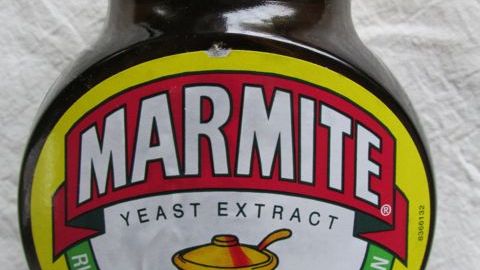
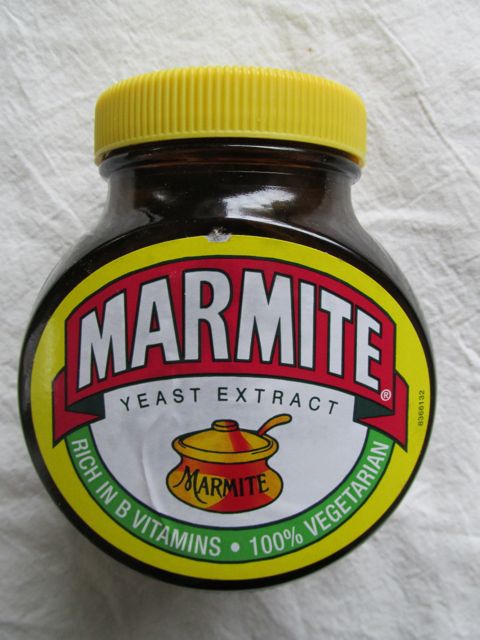
YUM!I’m taking a risk here. At this point at least half my readers will go ‘bleagh’ and move on, making horrible retching noises. That’s because people either love the dark savoury spread or hate the revolting black slimyness, depending – a fact Marmite have often used in their advertising.

I’m unusual in that I didn’t always love Marmite. In fact until about twelve years ago, I don’t think I’d ever tasted it. It was one of those things I knew I didn’t want to experience directly – rather like Morris dancing, plague or incest – and which I preferred to leave to other people (exactly like Morris dancing, plague and incest).

Just before I left London I was in my normal overcrowded coffee bar, picking up my breakfast espresso and croissant. The customer in front of me asked the new, very young, very French assistant for coffee and some toast and Marmite. The boss was distracted with my order, and we all suddenly noticed at the same time that the girl was slathering vast quantities of Marmite onto the toast. Everyone started shouting at once, but her English had evidently abandoned her in the resulting panic so I joined in with ‘non, non, non, c’est dégueulasse!‘ at the top of my voice. And at that time I did think it was – well, I suppose the best translation in these circumstances is ‘vomit-inducing’.

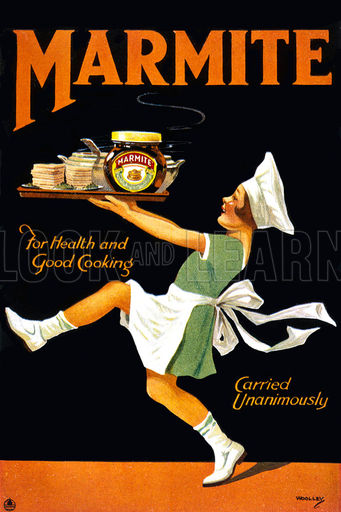
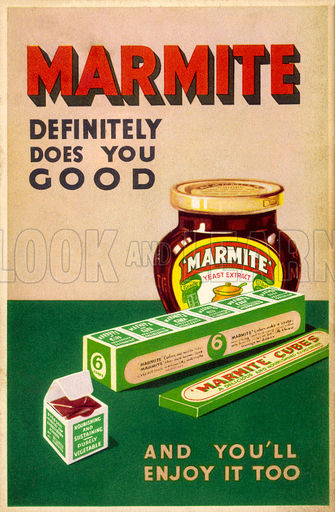
1929 campaignI’ve no idea when I went over to the dark side – I genuinely cannot remember. I’m not even sure when I started buying it in the biggest possible jars, the 500g – yes, that’s half a kilo -ones. I get through about three a year, and that’s just me… so what do I know about my toast topping of choice? It turns out, not a lot.

I knew it was a fantastic source of B vitamins. OK, it’s a bit on the salty side but you’re not going to eat it by the spoonful unless you are someone desperately trying to impress a young French girl working in a London coffee bar. It’s a by-product of the brewing industry, and a little makes a vast amount of difference to the taste of a stew. That was it.

Oh, I did know that the recipe and process were secret. That had filtered through. As had the fact that it is not the same as Bovril: dear lord, no. Bovril is made from cows and I don’t want to know what bits or how. Marmite is 100% vegetarian.

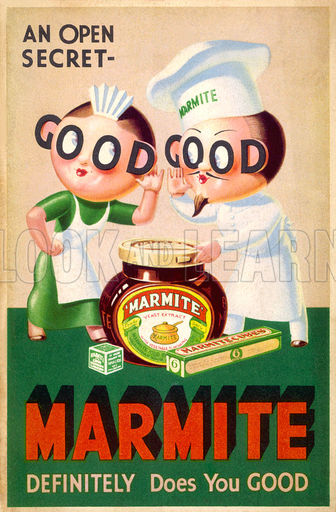
1930s ad• But I didn’t know that the first Marmite pots were earthenware, even though it is named after a marmite, traditionally an earthenware cooking pot. Somehow I thought it was always sold in the distinctive glass jars. In 1974 there was a jar shortage, and Marmite was sold in more conventional ones for a while. Some things are just plain wrong.

• I didn’t know that British troops in WW1 had Marmite as part of their rations, or that it was supposed to be particularly important for those serving in Mesopotamia, where deficiency diseases were thought to be more likely. It was also used as a vitamin supplement for German POWs held in Britain during the Second World War. And in 1999, British soldiers in Kosovo were sent their supplies.

• The BNP used a jar (and the company’s  ‘love it or hate it’ slogan) in an ad campaign, leading to threats of legal action if the ad was not withdrawn. Didn’t know that either. Of course, the ‘love it or hate it’ Marmite comparison has been used for numerous analogies, not just the BNP – yuk. It’s also been used to describe things as diverse as Wagner, test matches at Headingley, George Galloway, Russell Brand, Cath Kidston’s fabric designs, The Archers, Thought for the Day, Times New Roman, bagpipes, Boris Johnson, faith schools, Shirley Bassey, Twitter, Lily Allen and Ken Livingstone. There are many others… horse racing, for example. Enough, already. (Oh, and there are two Marmite board games and even a Marmite rap.) Ahem.

• Nor, thankfully, did I know about a couple of Marmite cocktails. No, no and thrice no. One involves vodka and yellow tomato juice and blackberry liqueur as well as other ingredients. The other, allegedly from a top London hotel, I’ve only heard about; it’s unsupported by concrete evidence and may have been so scary that its existence is subject to official sanction.

1930s ad• On a more positive note, I’d absolutely no idea whatsoever that Marmite was used to treat mill hands in 1930s Bombay; they were suffering from a form of anaemia and the remedy worked (that was because of the folic acid it contains). It’s also been used to treat people suffering from malnutrition.

• It is, however, banned in Denmark. It’s fortified with some other vitamins, and that makes it illegal there. Oh, all right – it isn’t, even though that’s how it was reported. Products which are fortified have to be licensed in Denmark; the company which imported Marmite wasn’t licensed and therefore stopped selling it. Not quite the same thing… but nearly. There have also been similar problems in Canada. And the idea that it was banned from prisons because it could be used to make hooch is just an urban myth. It isn’t, and it can’t.

• I didn’t know that the New Zealand version had a different taste. I knew it had different packaging, but I didn’t know it tasted all that different (‘less tangy’, apparently – it contains caramel and sugar, which the original does not). I also didn’t know anything about ‘Marmageddon’, the 2012-13 Marmite shortage in New Zealand and Australia, after the manufacturing plant was damaged in the Christchurch earthquake. Apparently there was panic buying. I’d have been there, storming the supermarkets.

And during Marmageddon ridiculous prices – up to NZ$800, according to some sources – were demanded for jars. This may or may not be completely true; it could be more press exaggeration. Anyone know for sure? Anyone spend NZ$800 on a jar of Marmite?

• And another question. It’s supposed to keep mosquitoes at bay. Anyone know if it works, and if it does, do you have to lather it on – as though you were that toast in a London coffee bar – or eat it? Just asking… even though I now love Marmite, there are some things I do not want to do. Almost as bad as the cocktail, in fact.

Right, time for toast!

Whatever happened to afternoon tea?

I’ve been fiddling about in the basement office – well, I say office, but at this time of year it’s a store for garden furniture, kindling and unwashed fleeces – and I came across a book from the 1980s, Jane Pettigrew’s Tea Time.

afternoon tea...A little idle flicking through brought instant nostalgia – for the habit of afternoon tea, not for the scary big hair in the author photograph: 1986 may have been a good year for teashops, but it was evidently a fantastic year for anyone selling hairspray.

A brief read of the intro was enough to make me realise that a great gulf of time had suddenly opened up, however. And some of the recipes – Downton, pure fantasy Downton. Admittedly they were self-consciously nostalgic even in the 1980s, but kidney paté on toast? Did anyone really make that? Devilled sardines?

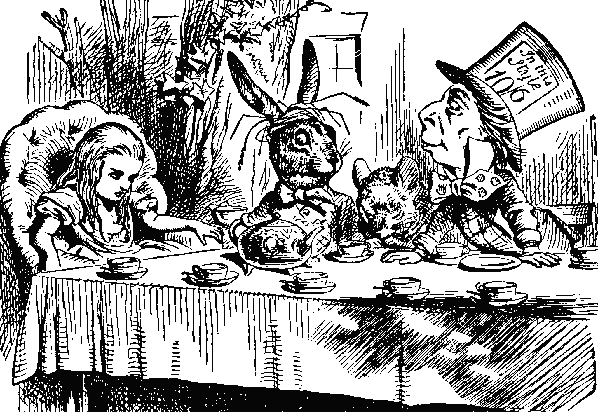
All of this made me think seriously about the role afternoon tea has played in my life. It’s barely conscious, but it is a constant. And it’s quintessentially British, too – not English, oh no, it’s got a fine place in Scotland and Wales, and in Ireland. Especially at funerals, but that’s a specialist sub-set of the afternoon tea. And of course it’s present in literature – the Mad Hatter’s Tea Party, for instance.

Alice

It’s been a constant for me for as long as I can remember (though dormice in teapots have been remarkable by their absence).

Constant right from being a child, when we regularly had afternoon tea at my grandparents, all fine china and salmon and something slithery my step-grandma called ‘shape’, or when we went on celebratory trips, all dressed up, to Betty’s of York. Then it persisted, in a bastard but equally enjoyable form, though college – Fitzbillies cakes and crumpets cooked by being slapped onto the bars of a gas fire – and my first years down in London, where I indulged at Fortnum and Mason; I know, I know, but I worked almost next door. It was a marked feature of holidays in Ireland and of holidays in Yorkshire.

(An Irish friend developed a Yorkshire–English phrase dictionary. This included such phrases as ‘let’s just stop for a cup of tea’, which was translated as ‘let’s just stop for a few buckets of tea, a sandwich, an unfeasibly large scone and a ginormous piece of chocolate cake’. I can’t think what she was going on about, really… it’s not unique to North Yorkshire. And nor were the arguments about who was paying, either. Think about Mrs Doyle and Mrs Dineen slugging it out over afternoon tea payment in Father Ted. and you’ve got about the right image – er, apart from our appearance, that is. We were both goddesses and neither of us wore a hat.)

But it’s not a constant now – or not in the classic sense. We seem to have lost the habit of afternoon tea. Or perhaps it’s just changed (and got infintely, unbelievably expensive if you will have it at the Ritz). No more devilled kidneys, no more sitting down over cucumber sandwiches with the crusts cut off, no more smoked salmon pinwheels. When did you last see a three-tier stand with sandwiches on one layer, little scones in the middle and elegant small cakes on the final one? Rather than one filled with lurid cupcakes or, more latterly, equally lurid macarons?

But there’s a lot more ‘meeting up for a coffee and a cake’ going on (and notice the pattern on the oilcloth – referencing afternoon tea):

coffee and cake

Perhaps we’ve turned Viennese, with our kaffee und kuchen instead. I’m not decrying that; I love it, it’s really enjoyable and damn near perfect when you’ve got good places to go like the Llew Glas Deli In Harlech and T H Cafe in Dolgellau (though there can be a downside, which I’ve moaned about elsewhere).

There’s no doubt that there’s a baking revival underway, with the Great British Bake Off, things like the Clandestine Cake Club and the popularity of cupcakes (they’re not popular with me, though: I detest the oversweet, sticky, tasting-of-damn-all-except-sugar, squishy little sugar transporters – and no apologies for repeating ‘sugar’, either). And there’s been an increased interest in good tea, too. But it seems to me that the interest in afternoon tea as such is more style than substance. So far.

Maybe it is time for a 1980s-style revival of the 1930s interpretation of the nineteenth-century tradition of afternoon tea. Maybe we need to be hunting out those china three-tier cake stands in junk shops and using them as they were intended to be used, and laundering damask tablecloths. Maybe we need to revisit parts of the 1980s – not the hair or the politics, please – and go full throttle for reinventing the British tradition of afternoon tea. It’s ideal, sometimes. If you’re going out in the evening, why rush over eating a meal which then leaves you doubled-up with indigestion in the theatre? Why not have a good afternoon tea instead? Oh, I know, work. It gets in the way of so much. But perhaps we could introduce proper afternoon tea breaks? Just a thought. No more polystyrene, get out the bone china. Yo!

well, quite

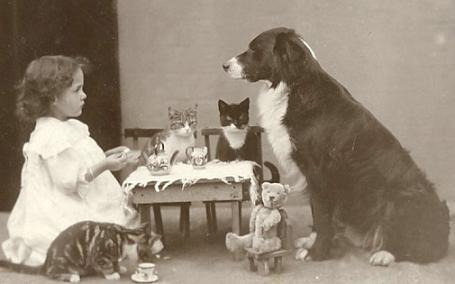
(I’m sorry about this. I found it on Pinterest, sans credit, and couldn’t resist…
Those animals are stuffed, and possibly the child too.)