All posts by Kate

Unknown's avatar

About Kate

Writer and editor, with an unhealthy (or rather healthy) obsession with food...

Tomato soup – the best comfort food ever?

I’ve been soooo busy. Not quite sure what I’ve been doing (apart from my tax return), but I’ve been rushed off my feet. And last weekend I suddenly had to give lunch to seven hungry spinners. Spinners of wool, ahem, not spinners on bikes – but they get just as hungry. Soup had to be one answer; it so often is at this time of year… and raiding the freezer had to be another.

Now, I admit it, I’ve a weakness for at least one tinned soup – tomato. Who hasn’t? Well, apart from people who either don’t like tomatoes, can’t eat tomatoes or who, as in my case, are lactose intolerant – my favourite, Heinz, has milk in it (‘dried skimmed milk, milk proteins’ to be exact), as many do. And most of the prepared tomato soups also are high in an ingredient which I don’t use in mine, and which is finally getting the negative press it deserves: sugar. Half a tin – half a tin – typically contains nearly 10g of sugar, 2 teaspoons. Yikes.
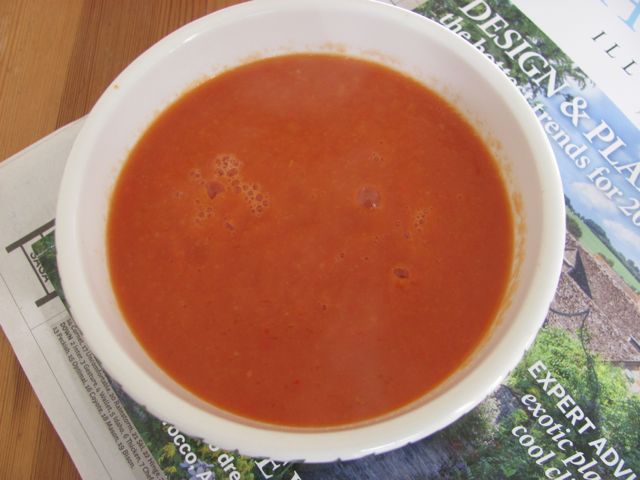
tomato and red pepper soupSo I recently set to work to produce as credible an imitation as I could, given certain variables, and I think I finally got there. As a result I had lots of single-portion containers stashed in the freezer, and boy did they come in handy. They weren’t all identical, as I’d been experimenting with different ways of thickening the soup, but they were close enough to work together well – and I just had enough for my starving spinners.

So here’s the recipe, and with the two most successful alternative ways of thickening the soup given: using a potato or some cannellini beans. For the latter, you can (of course) use dried beans instead of the tinned ones given in the ingredients; soak 120g overnight, then rinse and cook them until they are just soft before adding to the soup.

Tomato and red pepper soup
serves 4

1 tsp olive oil
1 large white onion, chopped
1 stick of celery, finely chopped
2 red peppers, de-seeded and chopped
2 large cloves of garlic, crushed
2 x 400g tins of chopped tomatoes
1 x 400g tin of cannellini beans, OR
1 potato, about 150g
half a tsp sweet smoked paprika (pimenton dulce)
a few thyme leaves
salt and black pepper

Warm the oil in a large casserole or pan over a medium heat and add the chopped onion. Stir it in, then put the lid on and sweat the onion for about 5 minutes; check that it isn’t catching. Then add the celery, the peppers and garlic and cook, lid off, for a further couple of minutes.

Add the tomatoes (if using whole tinned toms instead of chopped ones because that’s what you’ve got in stock, break them up in the tin first). Drain and rinse the cannellini beans, if using, or peel and chop the potato, and then add to the pan. Finally add the paprika and the thyme leaves, then stir everything together. Fill the empty tomato tins with water, swirl round to collect all the tomato juices, and add them to the pan too.

Cook, uncovered, for 20 minutes or until the peppers are soft; add a little more liquid (boiling water or hot vegetable stock) if the soup looks as though it’s going to be too thick, but try and wait until after blending because this soup is best quite thick, and it’s difficult to judge when it’s still in chunks. Blend the soup until it’s smooth, and then add more liquid to get the consistency you prefer. Reheat the soup, check for seasoning – and serve with some chunky wholemeal bread.

(On the sweet smoked paprika – it’s getting easier to find, but the most frequently stocked smoked paprika is the hotter one. The really useful sweeter version can be bought economically online if necessary, and a tin will last for ages.)


The elephant in the foodie room

I can’t ignore this one any longer, and I’m not apologising if it turns into a rant (though I’ll try and control myself, honest, keep my red flag furled and my barricade-building tools firmly in the shed).

Sometimes the world of food writing can seem a little precious. Obviously there are some great exceptions, from food campaigners to bloggers who push eating well on extremely little money, and they’re brilliant. But it really hit me in the run-up to Christmas this year, reading reviews and flashy ‘best-buy’ comparisons in the media, that many food writers appear to operate in an exclusively well-off, middle-class, home-counties bubble full of exclusive restaurants and exotic ingredients. And yet there is a massive food story going on at present which many people are failing to cover. It’s not glamorous, it’s not going to inspire an elegant table setting or chic contribution to a dinner party. But it’s everywhere; nowhere is immune, even my own community here in beautiful, picture-postcard Snowdonia.

When I was about thirteen, I remember asking my father about the lack of younger people in the part of Sutherland that was so dear to us. Ever political, he took care to explain the economic situation in detail, much of which I don’t remember clearly. But I do remember his closing statement, almost something of a cliché, but true nonetheless: you can’t eat scenery.

Living somewhere beautiful is no barrier to deprivation. Turn your back on the beautiful views and look at the increasingly run-down council estates; go off the main road and explore some of the ex-slate-mining towns and villages which the newer road has bypassed. We tend to think of economic deprivation as being an urban problem, but it isn’t. Recovery? What recovery? There isn’t much of one in some of the places I know well. And this is where the food banks come in.

food bank hoursEighteen months ago there was one official food bank in North Wales, in Mold. Now we are further into this alleged economic recovery we are apparently having, and strangely they have increased in number, and are continuing to do so. Food banks now cover more of Flintshire as well as Wrexham, Caernarfon, Denbigh, Welshpool, Bangor and even the jolly holiday town of Barmouth. And those are just the ‘official’ ones.

There are many other community- and church-based ones, such as one in Pwllheli. Some have a web presence (like the splendid Telford Crisis Network), but more do not and rely on word of mouth. Some are purely individual, prompted by highly-motivated people, such as one which sprang up in Rhyl recently. Their contribution isn’t quantified but, bearing in mind that Trussell Trust food banks alone fed nearly 350,000 people in 2012-13, it has been estimated that they have helped over 500,000. The Trussell Trust pulled out the number of children from their stats: 126,889 kids were fed by their food banks in the same period. These figures do not include this Christmas season, when some anecdotal evidence I’ve been given points to even more use.

I find it depressing that there are members of the current administration who decry the existence of the food banks which, according to them, are unnecessary and have a ‘political agenda’. There have also been comments about the banks supplying exotica, so let’s look at the typical shopping list recommended by the Trussell Trust (I was given a copy when the Barmouth bank started collecting outside local supermarkets, but it’s on their website). Powdered milk, sugar, a carton of fruit juice, bottled pasta sauce, tinned soup, baked beans, tinned toms, tinned sponge pud, tinned rice pud, cereals, tea, instant coffee, rice, pasta, tinned meat or fish, jam and biscuits. Pretty wild, huh? And it’s also been reported that some people have been returning those items in their boxes which require heating up. They can’t afford it.

Now I’d like to think about the reasons why people end up – at the end of their tether, having tried everything else and often deeply ashamed – using food banks. Yes, there are more food banks, so more people are using them (that’s the ‘reason’ given by some members of the government for their increasing use), but a food bank is not something that’s set up on a whim, nor can someone in need just materialise at a Trussell Trust food bank and demand some tins of rice pudding – they have to be referred. Right, here goes: benefit delays bring 29.69% of people; low income, 18.45; benefit changes, 14,65; debt, 9.52% – and so on. The full list is on the Trust’s website.

Presumably the Red Cross have a political agenda too, since they’ve also been organising food collections in the UK in the run-up to Christmas. The last time they were involved in large-scale food aid here was during WW2. Just saying.

I’m lucky, and I know it. It’s not that I’ve got lots of money – I haven’t; I’ve spent years working around the book trade and that does not bring you great riches, even when augmented by freelance journalism – but if I want a delicious bar of artisan chocolate from the farmers’ market, if I want to test the latest blend from a local coffee roaster, I can afford it. I’m sensible, though. I don’t see this as meaning that I have to miss out on anything, except possibly roast peacock stuffed with truffles, but sooner or later Lidl will add that to their frozen foods alongside the lobster. I am lucky. And it’s no great loss to me if I add a tin or two of soup to my basket, or buy something I normally would not, like powdered milk.

Just one final word before I get off my soapbox and back to cooking. In the 1920s, Joseph Rowntree didn’t contribute to the soup kitchens in York (another place long combining picture postcards and poverty), despite his wealth. Instead, he set up his Trusts to try and do something about the root causes; check out the Joseph Rowntree Foundation’s website for more up-to-date information on the whole issue. So while things like food banks will always be a sticking plaster, I take the view that the sticking plaster is necessary. People can and will be very generous (on one collection day before Christmas, the Tesco Extra shop in Talbot Green couldn’t cope with the amount being donated, for example; some people gave whole trolly loads to the Pontyclun food bank), but it doesn’t mean you should lose sight of the underlying wound…

Squash soup for a stormy day

The weather forecast is terrible; it sounds as though the end of the world is coming. In such circumstances I have one response (er, apart from a tendency to say ‘yeah right’ and ask if it’s been reported anywhere other than in the Daily Express). That’s to make vast quantities of soup. I’m not at all sure what the connection is – I like soup in summer too; a hot day and some chilled cucumber soup – but it seems to be inevitable. I shall just go with it and fill the freezer. Freezers.

SquashIn late November I met up with some friends at Machynlleth market. It’s one of the best markets near me – well, it’s quite near, about an hour away – and is often worth a trip. Plus there are some good places for coffee and some rather nice shops, but one of the big draws for me is the vegetable stalls.

There are several, and they are generally excellent. One is a particular favourite, and I picked up a beautiful Crown Prince squash for 80p, along with some romanesco and a heap of succulent banana shallots. I often grow squash but, depressed by recent poor invisible harvests, I failed to plant any this year. Clearly a mistake, given the good summer, but that’s gardening for you. This stall had several different varieties, all looking beautifully autumnal, but I plumped for the Crown Prince because it tastes gorgeous and keeps well. It certainly has, and this seemed the perfect time to turn it into soup.

There are all sorts of variants on the theme of squash soup. Some recommend roasting the squash first, but in general I find that this can make the soup a bit oily – for me, anyway. Maybe I’m too generous with my olive oil when roasting the chunks of squash, but I have tried it with very little and – well, neh. I’ve used lots of different recipes recently, some I’ve been editing and some I’ve just been trying for pleasure, but for me this simple version stands head and shoulders above the rest. However, you do need a well-flavoured squash (roasting can compensate for one that is less than thrilling); all, alas, are not the same. Butternut is probably the most reliable one, and one that is also easily available. That’s if you’ve not grown any Crown Prince, something I plan on rectifying next year. I’ve given two alternative flavourings, as well…

soupSquash Soup with sage or nutmeg
serves 3 to 4

1 medium squash
1 tsp olive oil
1 large onion, chopped
2 cloves of garlic, finely chopped
100ml good chicken stock
water or vegetable stock
1 small sprig of fresh sage or a few grates of a nutmeg
salt and black pepper

Using a heavy knife, chop the squash into slices or sections. Trim the skin off the squash sections, remove the seeds and chop the flesh into chunks about 2cm square (you should have about 650g of squash pieces).

Put the olive oil into a large heavy-bottomed pan and warm it over a medium heat. Add the onion, turn it in the oil and put the lid on the pan to sweat the onion for about 5 minutes. Check that it isn’t burning, giving it a good stir, then allow it to colour slightly – and add the garlic and put the lid back on for another minute or so.

Add the squash to the pan and turn it in, mixing everything together. Add the chicken stock and enough liquid to cover – go easy, because the thickness of the soup will depend on the type of squash and should be adjusted later (some squashes can turn out to be surprisingly watery, and adding lots of liquid at this stage would result in a thin soup). Add the small sprig of sage or some freshly grated nutmeg. Bring the soup to the boil then lower the heat and simmer for 15 minutes. Remove the sage sprig (which should hold together; if not, fish out any large leaves too) and continue to cook until the vegetables are soft. Blend the soup, and then thin it to the required consistency with water or vegetable stock. Reheat, season with salt and plenty of black pepper, and serve.

Some recipes suggest toasting the seeds and adding them as a garnish. However, they are better dried, and I prefer to lightly toast some pumpkin seeds in a dry frying pan and scatter those over the top. You can always dry the fresher seeds out for next time (or not).

OK, weather, you can do what you want now – and a simple bowl of soup will also be very welcome after all the richness of Christmas food, too. Maybe I’d better make more!

Hedgehog balls (aka healthy sweets, honest)

I’ve just realised two things – Christmas is quite close, and that it’s not quite as close as I thought it was. Somehow I managed to mentally – not physically, I’ve not been whisked away in Stewie’s time machine – lose a week. I’m putting it down to working like a maniac, but have happily got an almost clear run now (owing to thinking Christmas is closer than it actually is and packing everything in). So I’m having fun. I’m going to see The Hobbit this afternoon – a round trip of over 100km; it better be good – and I’ve been making my favourite sweets: Hedgehog Balls.

hedgehog ballI’ve been making these, on and off, for years and years and I honestly can’t remember where the original recipe came from, but it’s so adaptable that the version I make now probably bears no resemblance to it. The giving of the name, however, I can remember. They were named by a friend of mine who was, I think, about 6 at the time. All the adults fell about, and they’ve been known as Hedgehog Balls for the last five years or so.

These little darlings are perfect to make with children though be warned – the mess is phenomenal. Sorry, that should be PHENOMENAL, and that’s even when I make them without the aid and assistance of people under 10. Save cleaning the house (should you do such a reckless thing) for afterwards. But do make them, because they are worth it.

Oh, you’ll need a food processor; I hate to think what it would be like without – and a stick blender doesn’t cut it. Believe me, I know. And about 50 small sweet cases, the cuter the better. Plus, as you can tell from all the alternatives in the recipe, it’s very adaptable.

Hedgehog Balls
makes about 50.

50g pumpkin seeds
50g sunflower seeds
10g (2 level tsp) sesame seeds
400g dried fruit: I used 200g sultanas and 100g each of apricots and cranberries
50g almonds, hazelnuts or walnuts
25g dessicated coconut
a little nutmeg
1/2 – 1 tsp ground cinnamon
juice of 1 orange
additional ground nuts and coconut, to coat.

First, grind the seeds roughly – pulse only – and decant them into a large mixing bowl. Then add the dried fruit, halving anything big like the apricots and breaking up any gatherings of truculent sultanas. Grind the almonds quite smoothly and add them to the bowl. Decant the lot – carefully, ahem – into the bowl of the food processor. Set the empty bowl to one side.

HBs in prepAdd the coconut and spices to the mixture, then add some of the orange juice and process the mix – it should be thick and not sloppy, so be careful about adding more (you can always drink the rest, perhaps with Campari, just saying). Ideally, you want the mixture to have the texture of good – chunky, but not too chunky – mincemeat. If it is a bit too chunky, it won’t hold together when you start to form the balls, but it can always be returned to the processor for a final whizz.

Now the really messy bit begins.

Empty the dried fruit mixture back into the bowl. Grind some more nuts and put them in a smaller bowl, and put some dessicated coconut in another. Put out the sweet cases on a couple of baking trays and remove all animals, relatives, men who are hanging about trying to help themselves, toddlers, etc, from the kitchen. Older children are fine – in fact, they love this. Keep a damp rag handy, though.

Carefully form the mixture into small balls, just the right size to fit gently into the cases. Sometimes you will be able to roll them gently between the palms of your hands; sometimes they will need to be shaped with your fingers (and they should never, ever be thrown at your sibling or at the cat). Then dip each one, alternately, in the ground nuts or the coconut, making sure they are covered all over. Put them carefully in the sweet cases, and then put the trays in the fridge for at least an hour. They will keep for about a week, but they generally only last a day or so.

Now clean the entire house.

a clutch of hedgehog balls

Afterthought, before going so far as do do any actual housework: you could try substituting some Cointreau for the orange juice – I don’t, because of children. But you could. Hm, wonder how that would taste? Might as well add to the mess before I clear up…

Sausages, biscuits, coffee and crafts

Early FairThis last weekend saw the second Portmeirion Food and Craft Fair, so I grabbed my bag and went along. Portmeirion should, after all, be a great venue, packed with character and style. I didn’t go last year but I had heard some rather equivocal reports, so I was eager to see what was what for myself. And to see if there were any exciting new producers, people I didn’t already know who were doing something interesting.

First, the good news: it was busy. The car park was heaving, even though we got there relatively early, but the Fair itself was perfectly manageable. Second, the bad news: that changed.

It quickly became so busy that you couldn’t move in some places – where stalls had been laid out along a narrow path, for instance – and the stalls themselves were so cramped as to be inaccessible once three or so people were there. Good to see it so popular, but I wonder how many people gave up? I wanted to visit the Pant Du stand, for instance – they have a vineyard at Dyffryn Nantlle and also produce delicious cider – but couldn’t even get into the little marquee where, according to the plan and a hanging sign, they could be found. I could – temporarily, I’m sure – get near two brewers, but I wanted Pant Du cider (grumble). Time to move on.

FairThere were a couple of stalls selling seafood and there was plenty of good meat on offer, too. Some of the nicest sausages I tasted, and there were plenty, came from Oinc Oinc. I usually get them from their stall at the Porthmadog Food Market though, but I haven’t had the chance to try their ham there. Beam me up, Scottie – delicious. It was a pity I’d had a good breakfast, really (I should have known better), because they were doing hot ham rolls which looked and smelled wonderful.

But there seemed to be a lot of butchers, and almost no one selling vegetables – the closest was probably our wonderful mushroom grower. Interestingly, the stallholder at Cig Howatson, one of the butchers – with fabulous and really hot chorizo – said he’d never realised just how many people were vegetarian until he started doing food fairs.

biscuit heavenBy this time the Fair was getting seriously crowded, but one stall I did manage to get near was that of Cryms, cake and – ooooo, especially – biscuit producers. They don’t have a web presence yet which is a shame, because their lemon meringue biscuits were to die for and much, much better than you’d think possible (but they will have a website up soon). By the time I decided I really  couldn’t live without them, I couldn’t get near the stand. Rats.

But I did manage to fight my way back to an ethical artisan coffee roaster – and there was my new and exciting supplier. I’d no idea we had anybody doing something like this around here, and I’m really pleased to have discovered Poblado Coffi. The smells from that stall – which happily was inside, unlike most – were delicious, though unfortunately there was no facility for tasting (!). Hmm, this Fair definitely needs more thought if it’s going to be up there with the big boys, and there’s no reason why it shouldn’t be.

Quibble, quibble, quibble – I know, that’s me. But somehow I expected better of Portmeirion. I know they can’t police the people manning the stalls, so there’s nothing they could do about the one whose concept of customer service was heavy and universal sarcasm, but they can do some editing of stallholders and stall placements. As I said, there were, or seemed to be, a lot of butchers – the local meat is fab so that’s not surprising – and people selling preserves (some were shops rather than producers, which did add an element of variety) And there was a curious lack of a good chocolatier.

One other quibble concerned the crafts. Not their existence – I’m a craftsperson myself – but the lack of ‘editing’ when it came to stall placements (and again the fact that some were not actual craftspeople, but were retailing bought-in items). Yes, there were things like three jewellers all making ‘celtic’ silver jewellery and almost next door to each other, but more serious was the placing of some next to people frying bacon or sausages. Fabric and fibre take up smells really quickly, and the beautiful bags on one stall were beginning to whiff like a transport caff. And that was at the start of the two days; by the end they’d have been unsaleable – you expect better when you’re paying a decent rate for a stall. I wouldn’t like to see the crafts relegated to some sort of quarantine, but maybe it would be best to concentrate on one or the other. And to institute some sort of quality control.

snack timeSo was it worth it, and would I go again? Well, I discovered the coffee roaster, the amazing lemon meringue biscuits and the spicy, hot chorizo. I didn’t know about them. But most of the other stalls – and many were good; this isn’t to detract from that – were familiar (and the one I’d have liked to see wasn’t there, but she’ll be at the market in Dolgellau this weekend). If I go next year, I’ll make sure I’m there as the Fair opens, I won’t have breakfast and I will be out of there by, oh, 11.a.m. If I go. As most of it’s outside, that will depend on the weather as well.

Soups unite against the cold – pea and ham

I love soup. I’m a bit of a soup head, really; always have been, always will be. And it always, always astonishes me when people don’t make their own, because producing great soups is so quick, so easy and so affordable. Soup also freezes brilliantly, so you can make oodles and store the rest (though use heavily spiced soups promptly; spices can intensify). Admittedly some ready-made soups have a strong comfort factor – Heinz tomato being a case in point – but you can make much, much more, and with greatly reduced expenditure, and without any strange ingredients when you do it yourself. I don’t need extra ‘milk proteins’ with my own soup, for instance, and accidentally discovered a more-than-passable version of the Heinz fave while trying to factor those out (red pepper is key, BTW). I don’t need modified maize starch, added caramel or high levels of salt, either, and my butternut squash soup will contain a lot more than 12% butternut squash, and 0% additional preservatives. Grr.

There are some soups which, undeniably, might take a little longer than 30 minutes to cook, notably those involving pulses. But there are ways round this, such as cooking them while you’re doing other things or – for heaven’s sake – using tinned pulses or a pressure cooker, the latter not as terrifying a prospect as it once was. It’s not rocket science, and it saddens me deeply when I hear someone on the radio, as I did the other day, bemoaning the fact that they miss their grandmother’s soup. Takes too long to do, apparently, and the presenter agreed. It was pea and ham. How sad…

pea and ham soupSo, with ‘killer snow’ in the forecast (thanks, Daily Express), what better time could there be to come up with a quick and easy pea and ham soup? One that doesn’t involve buying a packet from the supermarket, either. No sodium triphosphate; no dextrose, no added ‘beechwood smoke’ whatever that is, no tricalcium phosphate, etc., etc – plus I know the ham it contains is ham I’d be happy to eat and not some miscellaneous bits of pig, only appetizing if you can’t see them ‘raw’.

Let’s not forget the aesthetic element, either. It’s a beauty – satisfying to the eye as well as the palate. Perfect for this time of year, with the sky suddenly darkening and sleet rattling on the window (maybe the Express was right). Even if it failed completely to help me with the crossword.

Pea and ham soup
serves between 4-6, depending on how thick you like your soup

2 small potatoes
1 small onion or 2 large shallots
1 tsp rapeseed oil
1 small pinch of salt
900g frozen peas
100ml unsalted chicken stock
75g ham offcuts from the supermarket deli counter

Chop the potatoes (leave the skin on) and the onion fairly finely. Warm the oil in a heavy pan over a medium heat, and add the chopped vegetables. Give them a stir in the oil, making sure they don’t stick, and add a small pinch of salt. Cover and leave for a couple of minutes, then add the chicken stock and stir.

Add the frozen peas, cover the pan again and let the peas defrost in the heat and begin to cook. Then add water to cover – about 750ml – and bring to the boil. Reduce the heat to a steady simmer and cook for 5 minutes. While the soup is cooking, pick over the ham pieces, removing excess fat as much as possible. Chop the pieces and add them to the pan, then continue to cook for a further 5-10 minutes, until everything is cooked and heated through thoroughly – note that it’s important not to overcook the soup as it will lose the gorgeous green colour. Blend it by hand, preferably, giving it a rough texture, and thin to the required consistency with water if necessary. But it is best nice and thick!

The last of the hedgerows

A couple of weeks ago a friend of mine told me about a conversation she’d had with some German tourists; they’d been surprised at the huge crop of berries in the hedgerows, and at how little use was being made of the excess – apparently they felt that the branches would have been stripped bare in Germany. This made me stop and look and, yes, there was still a lot of fruit in relatively good condition. So I dug out my walking boots, a bag and a useful stick and got the last berries in, just before the weather turned.

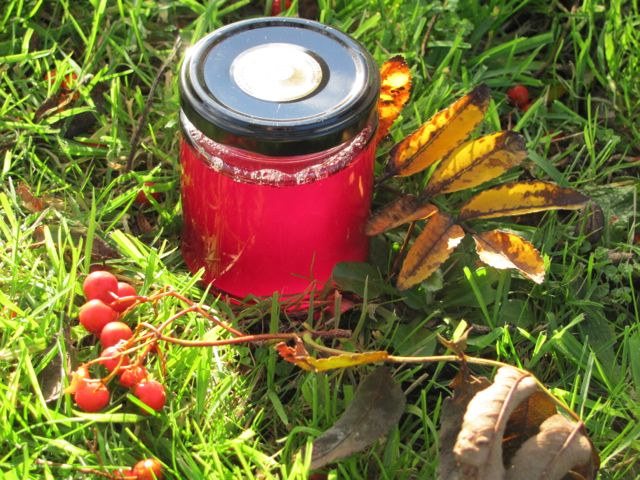
jellyLet me confess something. I’m not the best jam maker in the world. My damson is respectable, but I don’t eat a lot of jam and I’ve not really bothered to perfect my technique (you can’t make Marmite at home, alas). I do, however, enjoy making jellies. It may be largely aesthetic, though not having to pick seeds out of your teeth in an unladylike manner also comes into play. And my autumn jelly is sooo pretty; I can’t think how I had overlooked making it this year. So when I set off with my stick and bag I had a clear picture of what I wanted to find. Almost anything.

‘Almost anything’ isn’t fair, though. The jelly does need structure; it’s not a sling everything in and see what happens, compost heap of a jelly. Too many blackberries, for instance, tend to dominate and I often make a straight blackberry jelly with those as well. It also needs a certain proportion of crab apples for the set, and though my trees have been a bit straggly this year they managed to yield enough (a mystery; it’s been a good apple year in general). For the rest – well, I use whatever is available within reason. Elderberries can go in too, though I tend to save those for my elixir.

Autumn Jelly – five small jars

500g mixed autumn fruits – rose hips, haws, sloes, rowan berries, a few blackberries
500g crab apples
600ml water
sugar – the quantity depends on how much juice you get; see below…

Remove as many leaves and stalks from your hedgerow haul as possible, but there’s no need to be too finicky about small things like sloe stems. Roughly chop the apples if they are wildings – bigger than classic crabs, they are the product of ordinary apples discarded by passers by; just as good but need more chopping – otherwise, just halve them. Put all the fruit in a large pan, add the water and bring to a simmer. Cook until everything is soft and then allow the mixture to cool a little. Set up a jelly bag and stand or, if you’re like me, create one using muslin, string, and the legs of an upturned chair. Put a bowl beneath the bag and carefully ladle the contents of the pan into the jelly bag. Allow it to drip overnight.

In the morning, remove the jelly bag – for a really clear jelly, make sure you do not squeeze the bag before doing this – and discard the contents. Pour the liquid into a measuring jug; for this quantity of fruit, expect about 700ml. Then weigh out the sugar, 75g for every 100ml of liquid. Put the juice into a heavy-bottomed pan and bring it to the boil, adding the sugar just as it reaches that point. Stir carefully until the sugar has dissolved, then stop stirring and let the jelly boil vigorously until it reaches setting point; this should take about 7-8 minutes. Take the pan off the heat while testing for a set – I do this by putting a little jelly on a chilled dish, turning it upside-down over the pan and seeing if the jelly drips off; if it does, I boil it a little more. Once it’s fine, skim the jelly of any foam and pot it into warm sterilised jars, sealing immediately.

I love this jelly with cold roast chicken and a baked potato. Why did I think of that? I’ve only just had breakfast…

There is something deeply satisfying about making preserves. Every year the peak season seems to coincide with all sorts of other complications, but the one year I threw my hands up in horror and produced nothing I felt deprived (and guilty too). This year I’ve gone a little bit bonkers and have five different types of chutney – that bumper apple crop again – as well as this jelly and some damson jam. Could this behaviour be the human equivalent of a squirrel stashing nuts? If so, I generally like to think I have greater mental capacity than the average squirrel – after all, they forget where they stash things and rely on encountering them by accident. And then I cleared out the understairs store and found two jars of chutney from 2009. Ahem. Delicious, by the way.

Magic cure-alls – and elderberries

I’b had a code. I’b had a bad code. But becaud I’b dot a man, id wid be over soon. Seriously, this plague flu pox nasty cold comes from a nearby town and seems to affect everyone – but differently according to sex. With blokes, it’s a fortnight. With women, hee hee, oh, 48 hours… though I must admit that I’m still coughing. I have, however, had my magic solution to all colds / bugs / winter illnesses to hand, and am thanking heavens that I managed to find elderberries this autumn.

Strangely, for such a common shrub, elders are rather elusive round us. In North Yorkshire entire hedges are made of huge overgrown elders, heavy with frothy blossom in spring and bending with the weight of berries in the autumn. Near me, by contrast, nah – we guard ours. I try and spot them in the spring, marking them out closely for investigation later, and I have a few secret spots up in the hills where elders grow quite well, sheltered by abandoned farm steadings. I’m not particularly interested in making cordial, especially as each blossom removed means no berries, but they are easier to spot when they’re in flower.  And each year I also interrogate friends with elders: have they ripened? How’s the crop? Have the birds got to them? Do they want all the berries themselves, and if not pleeeeeease…..?

elderberry drinkThat’s because I need to make elderberry elixir. No, it deserves caps: Elderberry Elixir. Sneezing and sniffling, I turned up at a neighbour’s house a few years ago. She took one look at me, summoned me in, sat me down beside the stove and gave me a glass of something alcoholic, sticky and purple. It was delicious, definitely better than any cough remedy I’d encountered and, as I quickly discovered, seemed to work.

I’m not the only person to have noticed this. Elderberries have been well and properly researched and used to treat all sorts of things, not just colds. Success as an effective ‘cure-all’ might be down to the astonishingly high levels of Vitamin C they contain, as well as the fact that they are packed with antioxidants, particularly anthocyanins. It might be because of these (known or unknown) that elderberries have been seen as an effective remedy wherever they grow. They’re commonly used for all sorts of colds, coughs, bugs and bothers, and are even now being trialled in the treatment of some cancers. (In the case of my traditional recipe, I feel certain that the half litre of rum is also, er, useful.)

recipe noteI had to make my own. The recipe came to me in the form of a faded photocopy of a handwritten note. I had to fill in some gaps, but I’ve managed to make some every year since (and added my amendments – notably using less sugar – and some tweaks and extra bits and bobs). I try not to raid elders on roadsides, but if they are all I can get, they’re all I can get.

This year was not looking good; the birds had got to most of the berries before I could. And then I got a call from a friend. She’d been hacking down undergrowth and realised that there was a tall and straggly elder with plenty of berries which was now accessible. Power cables passed overhead, and that may be why the birds hadn’t gobbled up the whole crop – so I set off with a full-size shepherd’s crook (so useful for pulling down branches) and a plastic bag, prepared to deal with any I got immediately. That’s because if you pick elderberries and then leave them you soon have a bag full of grey-green fur: I know this. Off the tree, into the bag, back to the kitchen and into the pan, all within  the hour – that’s they key. Oh, and they catch quite quickly, too, when cooking – keep an eye on them.

So, as a public service, here’s the recipe – and you can use brandy or whisky instead of the rum; I’ve not tried whisky, but the brandy works a treat. My photocopy attributed this gem to Antonio Carluccio, but I’ve  not been able to track down an original. Nonetheless, let’s give him the credit. Go, Antonio!

Elderberry Elixir

2kg elderberries
200ml water
5 cardamom pods, crushed
15 cloves
2 cinnamon sticks, about 5cm long
juice and rind of a medium unwaxed lemon
750g caster sugar
500ml rum

You need a large pan – a stockpot is ideal. Strip the berries off the twiggy stems. This is easy if you run a fork down the stems and hold the bunches over the stockpot as you’re doing it; that way most of the berries go in the pot and not over the floor / walls / cat, which they will stain temporarily purple. Don’t worry about small twiggy bits. Add the water and cook the berries over a gentle heat for about 20 minutes or until the berries burst, then take the pan off the heat. Using a potato masher, squash the berries down against the base of the pan to extract the maximum amount of juice. Allow to cool a little. Suspend a jelly bag over a bowl as you would if making jelly, and carefully ladle the elderberries and all their juices into the bag. Allow it to drain overnight.

In the morning, squeeze any remaining juice into the bowl and discard the pulp; there will probably be about a litre of liquid, depending on the initial juiciness of the elderberries. Empty this into a clean pan and add the cardamom, cloves and cinnamon sticks, followed by the lemon juice and rind. Cook everything together over a gentle heat for about 10 minutes, then add the sugar and increase the heat a little to melt it. When the sugar has dissolved, bring the liquid up to the boil and cook it for another 5 minutes – you don’t want to reduce it as sharply as you do a jelly, but you do want to reduce it somewhat.

Let the mixture cool a little and then strain it into a bowl or large jug (it’s best to strain it through muslin rather than just relying on a sieve). Add the rum, mix it together well, and decant into sterilised bottles – I keep any good 50cl bottles during the year and use those. Seal and store; the resulting elixir keeps for a long time. In theory.

Oh yes: enjoy. And it does make colds go away. Really.

(I feel strongly about food writers who assume we all have obscure equipment lurking under our worktops but that’s probably because of editing some top chefs – ‘domesticating’ their recipes. And no, I do not have a sous-vide, surprising though that is, sunbeam, and I don’t think most domestic cooks do. OK – yet. I’ll give you that.
So here no-one
actually needs a purpose-made jelly bag. I’m still using a square of muslin tied at the corners and fixed to the legs of an upturned chair with string, though jelly bags are cheap and easy to find these days – I don’t have to behave as if I’m in a re-enactment project. But it works as well; just involves a bit more swearing.)

Hazelnuts, history – and a sweet treat

Phew. This is the foraging season par excellence, and I’m knackered. It’s a spectacularly good wild food year (so far) and this will be the first of several posts devoted to the art of getting something – at least partly – for free. It’s a wonderful year for nuts especially – a ‘mast’ year, when trees go into overproduction. Nobody really knows why it happens although there are many ideas floating about, but the net result as far as I am concerned is that the squirrels can’t keep up (and that’s one of the theories – overproduce, and some will be left to grow). But this also means that there’s a vague chance of me gathering some hazelnuts too.

Nearby are some woods where the hazels are both productive and accessible; some years I’m lucky and beat the squirrels and foraging dog walkers to the bounty, but I didn’t need to go there this time. I was in a friend’s garden a couple of weeks ago, near the woods,  and I suddenly realised I was walking on a carpet of nuts. My friend didn’t want them (?), so I gathered as many as I could – a sort-of public service, helping her tidy her garden.

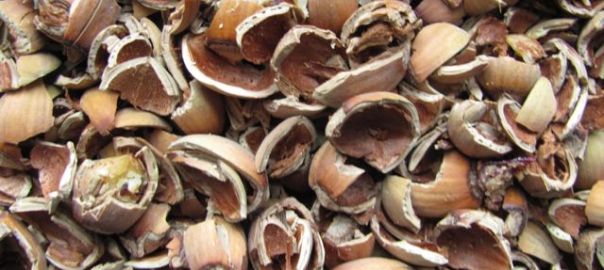
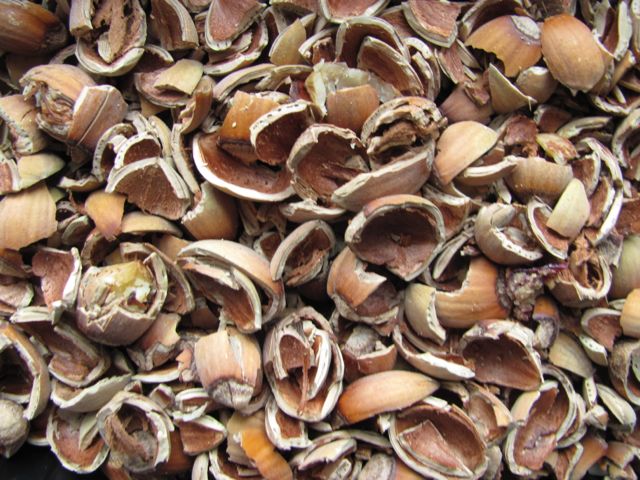
hazelnutsAs I sat in front of the television cracking the nuts, such a boring job, it struck me that I was simply doing what inhabitants of this area have been doing for time out of mind, and indeed what the prehistoric inhabitants of most of Britain would have been doing at this time of year. Except they wouldn’t have been in a comfy cottage watching Strictly (go Dave Myers!); they’d probably have been sitting outside a bender-like home and listening to someone telling stories about how the land their father used to hunt over was now too wet to walk on.

Once archaeology has bitten you in the ankle, in my case at the age of about six, it never lets go. The Mesolithic – the period just before the development of farming (if you can draw clear boundaries at all), when there was extraordinary environmental change – has always been my passion; let’s say broadly from about 9000BP to about 5000BP, depending on where you are. Hunter-gathering always held more appeal for me than a settled, farming life with the growth of hierarchy; it was a world I could relate to. And one of the major food resources exploited by the Mesolithic people of Britain was – drum roll, please – the hazelnut.

Like us, they’d have foraged for them at this time of year. Their harvest could have been stored (roast nuts store quite well, and many of the hazelnut shells retrieved from archaeological sites have been burnt), or they might have been processed in some way for future consumption – ground and made into a paste, perhaps. It’s also noticeable that the spread of hazel and the spread of people seem to keep pace; they were clearly a vital resource. There’s even some speculation that the growth of hazel was deliberately encouraged by setting fires which would clear the land. This would also make hunting easier – a double benefit – and there’s no way of telling (yet) which came first; they seem to be simultaneous. At Goldcliff East on the Severn Estuary there’s evidence of this firesetting, plus of the actual preparation of hazelnuts, plus – amazing, this – the direct traces of the Mesolithic people themselves: footprints. And we know hazels flourished in Doggerland before it was drowned; analysis of peat dredged up from the North Sea tells us this. And of course it wasn’t only the nuts; the bendy, flexible wood was useful for many things, too.

As befits such an ancient food, hazelnuts crop up in legend, myth and superstition all the time. Hazelnut shells can be used in divination on Halloween; the wood was sacred and used to kindle the need-fire at Beltane; the ‘milk’ of hazelnuts might be given to Scottish children born in autumn as their first drink because it would bring them good luck and health. In Celtic myth they’re a signifier of wisdom. Even in Victorian times ‘nutting’ had a suitably, er, outrageous and almost pagan reputation. In Flora Britannica there’s a reprinted complaint from the owner of Hatfield Forest: ‘…as soon as the Nuts begin to get ripe … the idle and disorderly Men and Women of bad Character from Stortford … come … in large parties’ – and got up to all sorts of things, and not just picking hazelnuts, ahem, ahem, filth. Disgusting.

I’d probably class as a Disorderly Woman, certainly when I was whooping about my friend’s garden, scooping up nuts. So what did I do with my haul? Recreate a Mesolithic house in my own garden and sit outside it, contemplating the level of the Irish Sea? Nah. When it came to it, I didn’t have that many – the nuts are often blind, and some of the ones I picked up had also been there too long. In the end I adapted a River Cottage recipe.

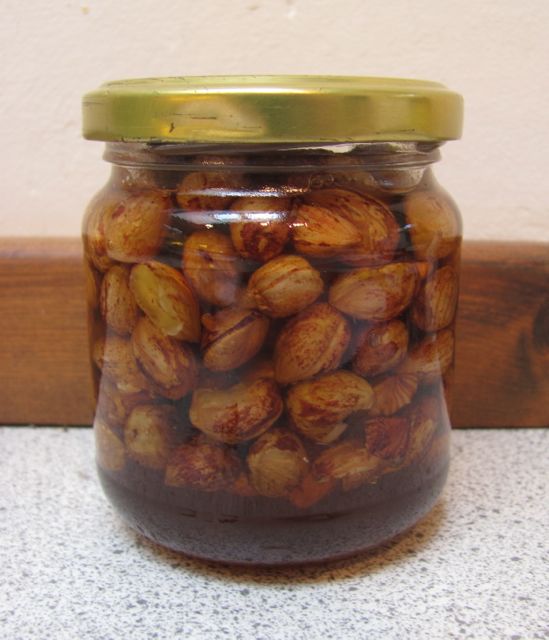
Toasted hazelnuts in honey hazelnuts

A quantity of hazelnuts
clear honey
Greek yoghurt

You never know how many hazelnuts you are going to have, so just adapt the recipe to suit. Find a small jar (or several if you’ve been lucky), and put it in a low oven to sterilise it while you shell the nuts (you can also sterilize a jar in a pan of boiling water, more economical and practical unless you have shedloads of nuts). Allow the jar to cool. Rub any loose skin off the shelled nuts.

Put a dry frying pan on the heat and put the hazelnuts in it. Roast the nuts, shaking them about so they don’t burn. When they begin to smell warm and toasty, take the pan off the heat and tip them onto a plate. Put a layer of nuts into the bottom of the jar, and add a teaspoon of honey, then more hazelnuts and so on, until you have run out of nuts, making sure they are covered in honey. Press the nuts down into the honey; they will float upwards, but just keep pressing them down as you use them (this is why you need a small jar). Cover the jar and set aside.

This mixture is absolutely delicious spooned over Greek yoghurt – you don’t need much, either. I tested them over ice cream (briefly – I’m lactose intolerant, after all) and found them too sweet, but that’s another suggestion. And they’re perfect on porridge, at least according to me…

And I’ve no idea how long they’ll keep because – well, because I’m eating them fairly quickly. I’d have starved to death in the Mesolithic.

Supermarket, shmoopermarket

trolliesOnce upon a time, I didn’t think twice. I popped into my car, popped down to Sainsburies, popped things into my basket, popped the money out of my purse and popped back home. There was a notable absence of local food shops in my (temporary) part of South London – there had been a traditional butcher, but he’d closed down – and no local market. I went up to Borough Market some weekends and could always pop to Brixton or Tooting if I needed anything more exotique. In all fairness, the picture when I visited my family in the country wasn’t dissimilar, except there was no Sainsbury. (It was dangerously northern and there was a time when whippets in cloth caps ate Sainsbury’s managers, or so you’d have thought; leek-chomping, daffodil-wearing dragons evidently still present a problem.)

In the past twelve years things have changed, and not only because I now live – nominally – ‘twelve miles from a lemon’, or – really – fifty-five from fresh yeast. More and more people have begun to question the role of supermarkets, and not just the predictable knit-your-own-yoghurt bunch who started avoiding them in the late 1960s. Questions have been raised about their ethics, about the way they treat suppliers, about the impact the arrival of a supermarket can have on a high street or small community, about the insidious, big-brother-like monitoring of their customers. (Got a loyalty card? You are being watched… and in my case they are watching someone called Mrs Xanthe Throngdribble, who is apparently 96 but who still works as a brain surgeon and lives with her seventeen children. I like filling in forms, sometimes. Then there’s also their monitoring of the aforementioned Mrs Throngdribble attempting to take a photograph of trollies in a supermarket car park. She’s got a surprising turn of speed for someone in her nineties.)

I have friends who won’t go near any supermarket, or who avoid a particular chain. And that does put more restrictions on you when you live somewhere remote than I’m prepared to accept, whatever I may feel about their vaguely sinister power. Most of the time I can manage perfectly well with the few local shops and a branch of the Co-op, and that’s what is available without a twenty-mile round trip. When Tesco opened a smallish branch in the town ten miles away a friend and I took about two hours to wheel our way through the excited crowds (in the words of Roz from Frasier, ‘there’s a town that badly needs a bowling alley’), being just as excited ourselves and greeting each new discovery with loud cries: ‘They’ve got lemon grass! Lemon grass!!!’

Now I could use the fact that much of my work involves ingredients I can only get in supermarkets as justification, but it would be a Potemkin village of an excuse. I do not want to have my choice of food restricted just because I live somewhere magnificent but comparatively remote, but I do want to do the best I can by shopping locally as much as possible. It’s a balancing act, and I don’t want to be doctrinaire. But there is one exception. Asda I will avoid if I can, partly because I can get what I want elsewhere, partly because it requires a longer journey and the use of more expensive petrol, partly because I hate the dark, cramped branch concerned and partly because they are a Walmart company and I really, really, really hate Walmart’s labour – sorry, labor – practices.

All of this means that I can build up quite a shopping list for those occasions when I have to go to a larger town, one with at least one large supermarket and maybe two or three, and one which is wonderfully a breath away from a small branch of Waitrose. The larger town also contains the big hospital, and it’s quite normal to get a call along the lines of ‘I’ve got to go and visit Huw tomorrow, do you want anything from Waitrose?’. It reaches the stage when you resent a hospital appointment that doesn’t mesh with their opening hours.

roadThere’s no more ‘popping’, of course. That’s partly because of the drive there – not one to be undertaken on a whim. There are essentially two choices, and they both take roughly the same time, about 90 minutes: the main road (roadworks, traffic jams at school time, motorbikes, caravans), and the mountains (roadworks, lycra-clad men on bikes, motorbikes, caravans). The main road is quite good, though with bottlenecks, but the mountain road is amazing – it’s behind the line of wall on the right and Snowdon is on the left out of shot. On a good day it doesn’t half beat the traffic jam at the bottom of Streatham Common; on a bad day it’s like doing your shopping by way of Mordor, complete with orcs in cycling gear looming out of the mist.

Last week I did some quick calculations. How much could I save by going to Bangor for X, Y and Z, allowing for the fact that I would have to spend A on fuel and take B hours to get there, at a potential hourly rate of C, given that I’m a self-employed writer and editor and not a 96-year-old brain surgeon? I factored in the N element – running out of Lingham’s Ginger Garlic Chilli Sauce – and the A/M/K essentials – getting stuff for friends – and set off.

Thursday was a Mordor day, but it was worth it. I got my X, Y and Z and saved at least £50 on those; I did my popping into to wild metropolis that is Bangor and had a drink in a coffee shop with a communal pine table and free WiFi, feeling all street and urban (think Blade Runner, oh, OK, I lie); I got my things in Waitrose. A few example purchases illustrate my point: some I could have bought anywhere but there was no point in making another trip when I was in Waitrose already (mushrooms, grapes); some I bought because I prefer the Waitrose own brands (small tinned tomatoes, anchovies); and some where enquiries about buying them locally would be met with ‘you must be joking’: pickling onions (why not???), camomile and lavender tea, linguine, Jarlsberg (I know some people think this Norwegian cheese tastes like rubber, but I like it), Greek basil, chilli crackers… and, of course, Lingham’s Ginger Garlic Chilli Sauce. I’m a happy bunny. So I really couldn’t be too much of a purist and abandon the supermarket altogether; getting even that little lot would have involved hours online, or trekking from small shop to small shop in a diminishing spirit of optimism, or growing my own. That’s an option I do explore, but you can’t grow bottles of Ginger Garlic Chilli Sauce. Xanthe Throngdribble is far too busy, plus she now needs another alias.